Lending a hand (30 December 2006).
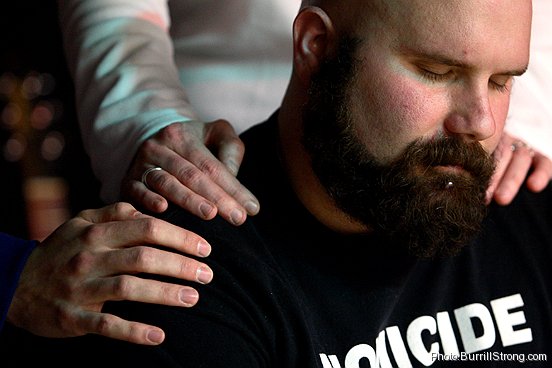
Mike Fischer receives prayer during a farewell service at his church. Fischer is preparing to spend six months in Africa serving with Mercy Ships. He leaves on the first of January.

Lending a hand (30 December 2006).
Mike Fischer receives prayer during a farewell service at his church. Fischer is preparing to spend six months in Africa serving with Mercy Ships. He leaves on the first of January.
We travelers, walking to the sun, can’t see
Ahead, but looking back the very light
That blinded us shows us the way we came,
Along which blessings now appear, risen
As if from sightlessness to sight, and we,
By blessing brightly lit, keep going toward
That blessed light that yet to us is dark.
-Wendell Berry
from Given: new poems
Earlier this week, I visited the ski slopes for the first time this season. That makes this the perfect time to air my frustrations with the habits of some of my fellow slope dwellers.
Before I go further, let me specify: I do not dislike all snowboarders. There are plenty that I do like. In fact, I would even consider marrying a snowboarder. (Well, that’s another subject.) Some of my frustrations involve snowboarders, but I am not exasperated with snowboarders as a whole. Just the exasperating ones.
(If you are reading this blog and you are a snowboarder, there is a good chance you are not exasperating. If you are reading this and you are a single female snowboarder, let’s have dinner.)
Anyway. On to the original topic.
My snow-loving friends:
I know there must be more complaints out there. Use the comment box to express them.
(Yes, that means you, too, snowboarders.)
No school like the old school (25 December 2006).
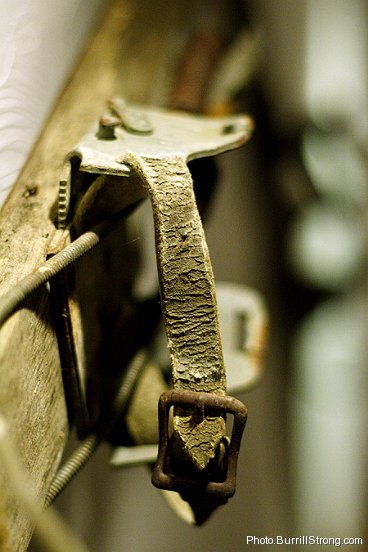
Antique skis decorate the walls of Boyne Mountain’s main lodge.
Schuss in Boots (25 December 2006).
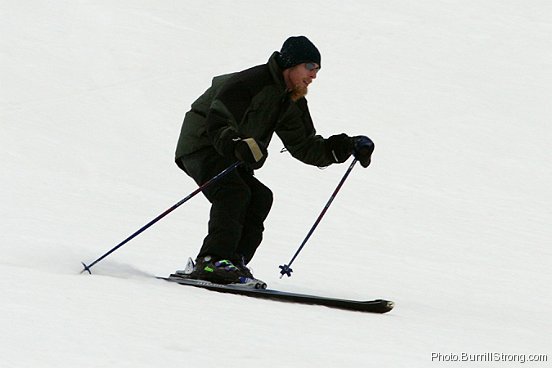
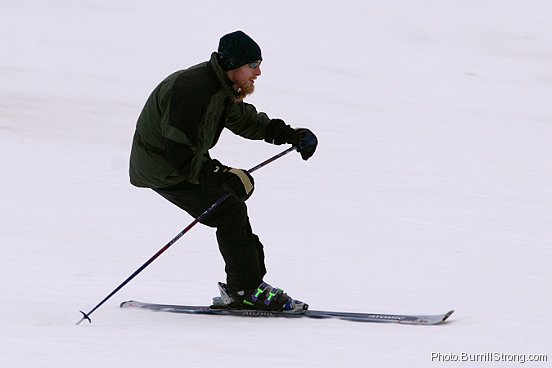
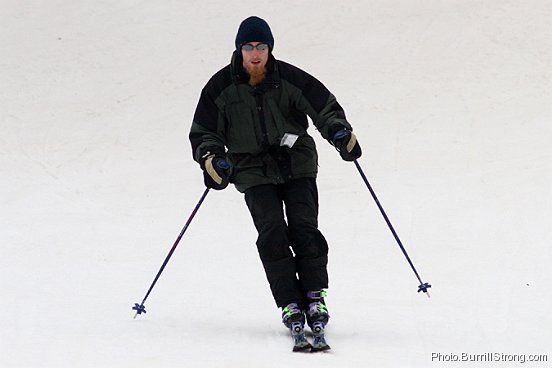
Guest photographer Bob Strong contributed these shots of me on the ski hills at Boyne Mountain on Christmas Day. I await your many critiques of my skiing form. (It would not be the first time.)
In a recent wish-list column on Sportsline.com, Ray Ratto made this wish:
We wish to care much less about World Series television ratings. If the games were good, fine. If not, fine again. But ratings are only a problem for the ratings department (read: six chimps with pocket protectors) at Fox.
Then, a few paragraphs later, he made this wish:Â
We wish to care much less about the suggestion that the NHL has fully recovered from the lockout. It hasn’t, not by a long shot, and the latest example is the fact that in the Bay Area, the game between the Sharks and Ducks, two of the three best and most entertaining teams in the league, were out-rating-pointed by a replay of one of the three California high school football championship games.
I’m confused. Do ratings matter or not?
04 November (2004)
Let’s Leave Fraud to the Professionals; Isn’t That Why We Elect Them?
Now for something absolutely hilarious. When I was on ABCNews.com, I was reading the transcript of an 01 November interview Peter Jennings had with Kerry. The intention of Kerry’s statement seems quite clear, but his phrasing is unfortunate and highly amusing.
JENNINGS: What have you done, as the leader of your party, to make sure there will be no fraud?
KERRY: There’s not going to be any fraud on our part. That’s the job of election officials.
(Note: the rest of his answer, none of which related to the unintentional election official humor, can be found at the link.)
A friend sent me a link to Time Magazine’s Person of the Year article. I already knew who the Person of the Year was, but I decided to click the link. Before I was able to view the article, I had to view an advertisement for the Chrysler Sebring.
Ordinarily, this would have been dull, but this particular advertisement caught my eye. In fact, I was compelled to click “replay” — twice! — but not because of any clever wit or creativity in the advertisement. No, I viewed it three times because of the message it contained:
“You might not be Time Person of the Year. But you can drive like you are.”
After viewing that advertisement, I arrived at the article, which, of course, names as its person of the year:
“You.”
On yesterday’s NBA fight post, js’ comment raised a fun concept:
As long as they keep it on the court/field/rink/pitch (ie, no going after fans) and pick on people their own age/size/etc (ie, no going after 80 year old pitching coaches with metal plates in their heads, or whatever that Red Sox fight involved) and stay within accepted boxing rules (ie, no using baseball bats or chairs or helmets [Miami (FL)]), I say stop the game, get everyone else out of the way, and let them go at it. Make them go at it. Maybe it’s not so great when you actually have to fight someone.
After reading that idea, I realized that controlled fighting already exists. No, not in the NBA, but in the NHL.
Consider the standard NHL fight: two players drop their gloves, play stops, and everyone else clears the area to watch the fight. The combatants land a few punches, someone falls to the ice, and they both skate off the ice. That’s it. Fights aren’t extraordinarily common, but when they do happen, they’re consistent and contained.
It would be nice to be able to tell athletes to finish all the fights they want to start; it might reduce the absurd bravado many athletes feel safe displaying. Unfortunately, I suspect hockey fighting wouldn’t translate well to other leagues: as odd as this may sound, I’m not sure other professional leagues could keep it as civil.
Over the weekend, the Detroit Pistons and the Indiana Pacers were involved in a fight. Late in the game, Ben Wallace committed a hard foul on Ron Artest; before long, the fight spread across the entire court.
No, wait. I mixed up a few details.
Actually, over the weekend, a fight occurred between the Denver Nuggets and the New York Knicks. When Denver had a comfortable lead late in the game, New York’s Mardy Collins committed a hard foul to prevent an easy fast break basket by Denver’s J.R. Smith. Naturally, the foul led to pushing, shoving and punching, because that’s the natural result of a foul. Or something like that.
I would go into detail, but I think there’s enough play-by-play — or shove-by-shove — available. Perhaps this brief formula will tell the story:
(Detroit + Indiana) – fan involvement = Denver + New York.
After the infamous Fight Night at the Palace, I wrote, “The level of reverence [professional athletes] receive in modern culture should compel an equally high level of personal responsibility.” That is still true.
Unfortunately, that message does not seem to be reaching the right people.