It’s been one year.
On Saturday, 07 January 2006, I drove to work. What seemed to be a slightly warm January morning was, in fact, a morning just warm enough to seem benign and just cold enough to be dangerous. The precipitation was just a mist in the air, but it was freezing when it hit the ground. Unfortunately, the only clue I had was a thin crust of ice on my winshield. I didn’t notice ice on the sidewalk and driveway, nor did I notice ice on the road as I drove to work. At least, not at first.
At the edge of Ann Arbor, there is an awkward, sometimes hazardous entrance ramp to I-94. The ramp features a sharp curve just before it merges with the highway, leaving little opportunity for merging vehicles to gain highway speed before they merge; worse still, it merges just as the highway is both curving and rising for an unpleasant overpass. Even in good weather, the ramp’s merge point presents problems; on that Saturday morning, that merge point was the point at which I stumbled into one of the iciest mornings in recent memory.
In order to give room to any merging traffic, I was in the left lane as I approached the curve. Another car was just ahead of me, and in the right lane next to the car was a semi. As we began the curve, the semi noticed traffic on the entrance ramp, and quite courteously, he signaled his intention to shift left so as to give the traffic room to merge. Equally courteously, the car in front of me slowed to allow the semi into the left lane. When I saw brake lights in front of me, I, too, pressed my brakes, and quickly discovered the unintended consequences of the string of courtesies. Because I had driven onto a sheet of ice, rather than slowing, I went into a clockwise spin and proceeded forward at much the same speed.
At that point, for just a few moments, the world went into a bit of a blur, both in reality — spinning even at slow highway speeds does make the world blurry — and moreso in my memory. As my car began its graceful dance, I remember thinking, “Here we go again”; just a moment later, I heard a crash at the back of my car. That crash stopped my spin and brought me to rest on the inside shoulder of the curve, just before the entrance ramp’s merge point. (I later realized I’d hit the semi in the right lane.)
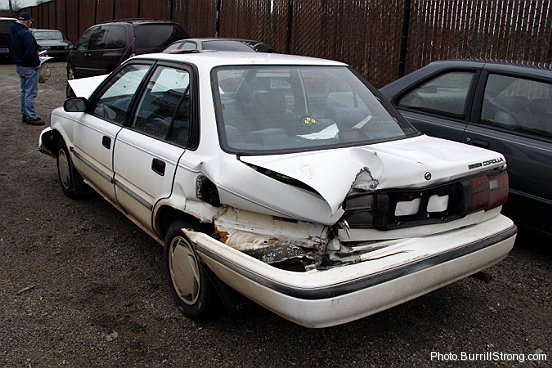
When I came to a stop, I knew only that I had spun off the highway and that I had sustained damage to the back of my car. To make the morning more interesting, I had spun only 180 degrees, so I was actually facing traffic. With no way of knowing the severity of the damage and no apparent safe and easy way to move the car further off the road, I followed conventional wisdom and stayed in my car to wait for help.
As I made a few relevant phone calls, I nervously watched traffic round the curve and react with surprise at the unusual sight of a vehicle on the shoulder facing traffic. At first, I was unhappy, both because I had crashed my car and because I had added yet another blemish on my already-stained driving record. But before long, my spirits lifted.
After a short time of watching traffic navigate the curve safely, I saw another driver tap his brakes when he saw my car, and when he lost control at the same place, he was able to sympathize with my plight.
Once he broke the ice (so to speak), the party began. Vehicle after vehicle encountered the same icy patch that had sent me off my merry way, and vehicle after vehicle lost some degree of control. With every car that lost control, I felt a little bit better about my situation; as insensitive as it may seem, each new out-of-control car brought some small vindication of my driving skills.
Of course, as the parade of cars lost control, I was still in my car on the side of the road. Far from being a safely separated onlooker, I had the potential to join the parade at any moment. Because I had come to a stop on the inside of the curve, I stayed out of the fray for a few minutes. But, of course, that didn’t last.
As traffic continued to discover the ice, a fire truck drove down the entrance ramp and stopped next to my car, and several firefighters emerged from the truck and began checking on the occupants of each vehicle to be sure there were no serious injuries. When a firefighter came to my car, I opened my door. He asked me if I was okay; I said yes, and he told me to stay in my car. I closed my door, refastened my seat belt and waited for further instructions.
Shortly after the firefighter checked my condition, traffic finally spun in my direction.
There is nothing pleasant about the sounds of a vehicle losing control on ice-covered roads: the sound of tires helplessly sliding across the ice, typically followed by the sound of the vehicle impacting another vehicle, or some roadside object. I heard those sounds far too much that morning, but it was the sounds of one particular impact that stuck with me.
After about ten minutes of watching traffic slide past my car, I looked forward and saw a white full-size pickup begin to lose control. By that time I had become oddly accustomed to such a sight, so for a moment it was nothing special. But before long, it caught my eye for a very important reason: while the rest of the vehicles had been consistently sliding through the outside of the curve, this truck decided to rebel by sliding to the inside of the curve — directly toward me.
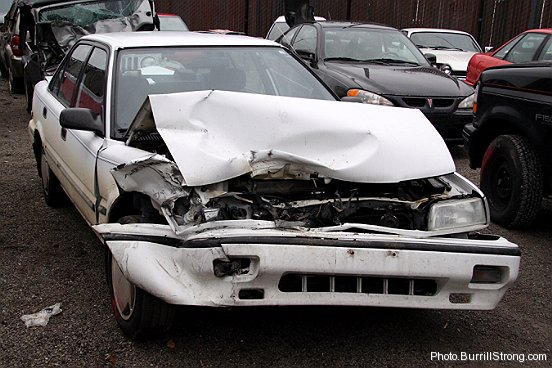
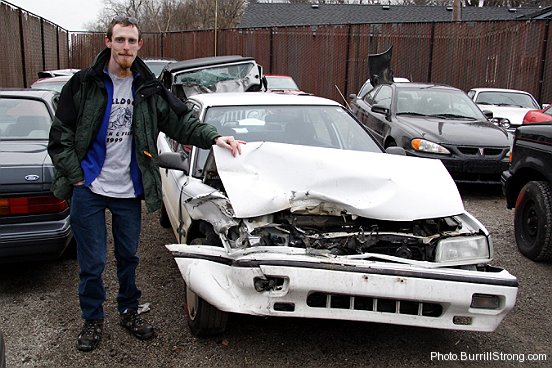
Some speak of such moments of frightening anticipation and say everything slowed to a crawl before the climactic moment, but I cannot make such a claim. I know I watched the truck lose control, begin its spin and slide towards me, but there was no slow-motion for me. When I saw the truck begin drifting to the inside of the curve, I gripped the steering wheel, and in no time at all the impact was done. My car had been pushed backwards, and its hood was shorter than it had been just seconds earlier. I didn’t know the extent of the damage to the back of my car, but after the second impact, I knew my car was totaled.
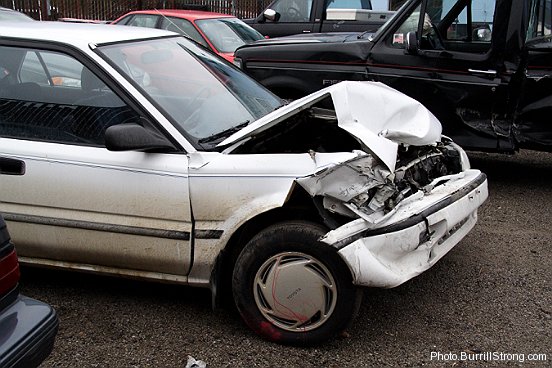
That collision brought the firefighters scurrying back to my car; I opened my door and let them know I was still okay. In a contrast that became humorous in hindsight, just a few minutes after they had told me to stay in my car, the firefighters told me to get out of my car and get past the ditch into the trees. I escaped my battered car for the safety of the trees and shivered in the cold as I watched the chaotic scene.
As emergency crews scurried from car to car, a police officer provided a much-needed light-hearted moment. Shortly after I took refuge in the trees, she approached me and asked a few questions concerning my role in the mess. She took my license to record my name, and, upon seeing my name, told me she had gone to high school with my brother. I couldn’t help but smile: in the middle of all that chaos, she recognized my surname.
By the time I spoke to the officer, the icy January morning had me shivering as I waited in the trees. To make matters worse, I was beginning to feel the physical effects of the crash; my knee and my chest were beginning to hurt. (My knee was very sore from hitting the dashboard, and my chest hurt because of the seat belt.) So, after answering her questions, I asked her if there was a place I could go to sit down and get out of the cold. She kindly offered her car.
The walk to her car, parked on the highway shortly past the entrance ramp, provided a startling picture of the dangerous conditions I had encountered. As we approached her car, I discovered that the road was simply a sheet of ice; the officer told me she nearly slipped and fell when she first stepped out of her car. But walking cautiously, we reached her car without incident.
Though the back seat of a police car is understandably uncomfortable — the hard plastic seat is an appropriate complement to the minimal leg room — it was an extraordinarily welcome relief for me. She returned to the task of sorting out the morning’s mess on the highway; I began making more phone calls.
Before long, someone moved the car; a few minutes later, another officer moved me to another vehicle. Finally, a city bus arrived so everyone involved in the pileup could stay warm; I spent the rest of the morning on that bus.
I could spend too many words recounting my time on the bus: the Red Cross’ bringing breakfast for all of us; the kind bus driver giving me the sports section he was reading; my brief conversation with the man whose truck crumpled my Toyota (he offered a sincere apology); my conversation with the police investigator. But as some of you may already know, this narrative is still vastly incomplete; I have not yet mentioned the central point of the chaos of that morning.
Believe me: I have not forgotten.
Shortly after the pickup truck collided with my car, as I was deciding that I was in better shape than my car, I caught a glimpse of something in my rear view mirror. It was just a glimpse, so I didn’t know what I’d seen.
After I retreated to the safety of the trees, the police officer told me the sad details of the collision that had occurred just behind my car. Another pickup truck lost control and caromed off the center wall and another car, and before it finally came to a stop, it struck Amy Schnearle-Pennywitt, an Ann Arbor firefighter. They rushed her to the hospital, but her condition was critical.
The news began to hit home as we walked to the officer’s car. We walked past the place the drastically unfair collision had occurred, and I saw an image that still remains vivid in my mind: Schnearle-Pennywitt’s helmet was lying on the icy pavement, acting as an incidental premature memorial to a woman who still held a tenuous grasp on life.
I had my own aches and pains from my collision, but I could not stop thinking about Schnearle-Pennywitt. Her condition remained critical, and I hoped and prayed that she would survive. After a while, when the bus happened to be mostly empty, I discovered that I was not the only one praying.
I looked toward the front of the bus and saw another man who had lost control on the ice. He was hunched over a small Bible — something that caught my eye not just because it was a Bible, but because it seemed to be a Gideon Bible — and he was clearly emotional. My father, a longtime Gideon, was on the bus with me, waiting to give me a ride home; I pointed out the Bible, and my father approached the man to see if it was a Gideon Bible. The man was indeed reading a Bible distributed by the Gideons, and when my father asked where he had encountered the Gideons, his answer also explained his strong emotions: he was a firefighter, and he had received the Bible during a Gideon distribution at his firehouse.
After several hours of waiting, the police investigator told me I could leave; before I left, I walked to my car to retrieve a few items. That was the first time I was able to see the the scene in the daylight. Most of the vehicles were gone, but my car was still there, and much like the road, it had a thick coating of ice due to the morning’s freezing rain; when I opened the door to find what I needed, I was amazed to see what the force of the impact had done to the loose items in my car. As I viewed the damage on the outside and the mess on the inside of my car, I became even more grateful that I had been able to walk away from the crash.
In the days following the accident, I kept an eye on the news, desperately wanting to hear some sort of positive update on Schnearle-Pennywitt’s condition. Sadly, that news never came; six days after the accident, she died. Her family chose to have a public memorial service; I knew without a doubt that I would be there. So, ten days after the accident, I walked into the University of Michigan’s Crisler Arena, not knowing what to expect but knowing I needed to be there.
The service was well-attended. Hundreds of firefighters, police officers and paramedics made the trip to pay their respects to Schnearle-Pennywitt; thanks to the volunteer services of area firefighters, every Ann Arbor firefighter was able to attend. I spent much of the service in tears, particularly during the ringing of the symbolic final alarm. At the end of the service, the firefighters, police officers and paramedics filed out the arena tunnel — a procession that took fifteen minutes — to prepare for the long, slow drive to the cemetary in Schnearle-Pennywitt’s hometown outside Ann Arbor.
When I stood to leave, a woman sitting being me asked if I was a family member. I said no, and I explained my reason for attending the service. When I told her I had been involved in the pileup that cost Schnearle-Pennywitt her life, the woman said she was a reporter for the Ann Arbor News, and she asked if she could interview me. I agreed, and she began to ask me questions about the accident and about my motivation for attending the service. With my emotions still strong from the service, I found it difficult to hold back my tears as I answered her questions. I didn’t know if she was going to use any of my sentiments in her account of the memorial, but really, I didn’t care.
The next day, I discovered that she had done more than just use me in her article. She made me her lead.
After the hundreds of uniformed men and women filed out of Crisler Arena to the sound of bagpipes, and the flag-draped casket was carried to the hearse through two lines of firefighters standing in salute, one man sat alone in the stands Tuesday, his head in his hands.
Burrill Strong of Chelsea was among the dozen motorists involved in a succession of spin-offs on icy eastbound I-94 at the Jackson Road entrance on Jan. 7. Ann Arbor Firefighter Amy Schnearle-Pennywitt had just arrived on the scene to help when she was struck by a pickup truck that spun out of control.
In the days after the accident, while Schnearle-Pennywitt was hospitalized, Strong awaited news, hoping for her recovery. When he heard she died last Friday at a University of Michigan hospital, he knew he had to attend her funeral service.
The article went on to recount my expressions of respect for Schnearle-Pennywitt’s willingness to put herself in danger for people she didn’t know.
I wasn’t sure what to think of being featured so prominently in the article, but the reactions I received told me that I had managed to say what I wanted to say — or, perhaps, what I needed to say.
After the memorial service, I began to leave that icy January morning in the past. I needed to mourn Schnearle-Pennywitt, and the service fulfilled that need. My only losses on that morning were a car and my overconfidence behind the wheel; I have another car and I have my health.
It’s been one year, and I am blessed to have had that year.
—–
On 17 January 2006 — the day of the memorial service — I wrote down these thoughts.
Those who live their lives in service to others are most widely recognized when they have lost their lives in service to others. This has been freshly reinforced by the events of the extraordinarily icy morning of 07 January 2006.
I was in one of the 13 vehicles in the pileup on I-94 east at the Jackson Road entrance on that Saturday morning. My car spun on the ice and stopped on the shoulder. Having come to a stop facing traffic, I watched a number of vehicles lose control before one pickup truck lost control and slammed into the front of my car, totaling my car but leaving me only bruised.
Around that time, I looked in my mirror and saw what I thought might have been a person being hit by a vehicle. A few minutes later, I learned what we all now know to be true: a firefighter had been hit by a vehicle. A dozen other vehicles had lost control in that same place, but only one had such a stunning result. Shortly after that incomprehensibly unfair collision, traffic finally came to a halt.
And now, a week and a half later, as a person who normally finds himself with an excess of words, I am finding myself having difficulty writing just a few paragraphs. It is difficult to know what to say in the face of such grief, from that of the Ann Arbor Fire Department to that of her family and her husband. There is no imagination vivid enough nor verbiage powerful enough to comprehend or express their emotion and their loss.
But what persists in my mind is simply this: Amy Schnearle-Pennywitt, along with the rest of the firefighters, put herself in obvious danger to protect the lives of strangers, of whom I was one. Instead of waiting for the highway to be closed, the firefighters risked their lives — a very real risk in a very dangerous situation — in an effort to ensure the safety of motorists they didn’t know. It is absolutely tragic that she was killed in an accident beyond anyone’s control, but she gave her life while helping a group of people she didn’t know.
As one of those strangers, I would like to offer my prayers for the fire department, her family and her husband, and I would like to express my deep gratitude for the service of the firefighters on that call, and especially for Schnearle-Pennywitt’s service and sacrifice as a firefighter. She gave her life in the service of others, and that is selfless and admirable. It is what I will remember about a woman I never knew who gave herself for those she never knew.