TV good, TV bad

In a recent wish-list column on Sportsline.com, Ray Ratto made this wish:

We wish to care much less about World Series television ratings. If the games were good, fine. If not, fine again. But ratings are only a problem for the ratings department (read: six chimps with pocket protectors) at Fox.

Then, a few paragraphs later, he made this wish: 

We wish to care much less about the suggestion that the NHL has fully recovered from the lockout. It hasn’t, not by a long shot, and the latest example is the fact that in the Bay Area, the game between the Sharks and Ducks, two of the three best and most entertaining teams in the league, were out-rating-pointed by a replay of one of the three California high school football championship games.

I’m confused.  Do ratings matter or not?

You put your right fist in, you take your right fist out…

On yesterday’s NBA fight post, js’ comment raised a fun concept:

As long as they keep it on the court/field/rink/pitch (ie, no going after fans) and pick on people their own age/size/etc (ie, no going after 80 year old pitching coaches with metal plates in their heads, or whatever that Red Sox fight involved) and stay within accepted boxing rules (ie, no using baseball bats or chairs or helmets [Miami (FL)]), I say stop the game, get everyone else out of the way, and let them go at it. Make them go at it. Maybe it’s not so great when you actually have to fight someone.

After reading that idea, I realized that controlled fighting already exists.  No, not in the NBA, but in the NHL.

Consider the standard NHL fight: two players drop their gloves, play stops, and everyone else clears the area to watch the fight.  The combatants land a few punches, someone falls to the ice, and they both skate off the ice.  That’s it.  Fights aren’t extraordinarily common, but when they do happen, they’re consistent and contained.

It would be nice to be able to tell athletes to finish all the fights they want to start; it might reduce the absurd bravado many athletes feel safe displaying.  Unfortunately, I suspect hockey fighting wouldn’t translate well to other leagues: as odd as this may sound, I’m not sure other professional leagues could keep it as civil.

They just couldn’t wait for the new Rocky movie

Over the weekend, the Detroit Pistons and the Indiana Pacers were involved in a fight. Late in the game, Ben Wallace committed a hard foul on Ron Artest; before long, the fight spread across the entire court.

No, wait. I mixed up a few details.

Actually, over the weekend, a fight occurred between the Denver Nuggets and the New York Knicks. When Denver had a comfortable lead late in the game, New York’s Mardy Collins committed a hard foul to prevent an easy fast break basket by Denver’s J.R. Smith. Naturally, the foul led to pushing, shoving and punching, because that’s the natural result of a foul. Or something like that.

I would go into detail, but I think there’s enough play-by-play — or shove-by-shove — available. Perhaps this brief formula will tell the story:

(Detroit + Indiana) – fan involvement = Denver + New York.

After the infamous Fight Night at the Palace, I wrote, “The level of reverence [professional athletes] receive in modern culture should compel an equally high level of personal responsibility.” That is still true.

Unfortunately, that message does not seem to be reaching the right people.

College football: old and improved

There is controversy in the BCS. Again.

Second-ranked USC, the team most assumed would be playing Ohio State in the postseason, lost to UCLA; fourth-ranked Florida beat Arkansas in the SEC conference championship. Third-ranked Michigan, the team that many analysts initially decided was better than Florida even after losing, finished its season two weeks earlier. But despite Michigan’s being idle, and despite Florida’s failure to use its last two games to assert itself as superior to Michigan — particularly in an anemic effort against unranked Florida State — the Gators passed the Wolverines in the final poll.

Many explanations for the position switch held to one of several common themes: Florida won its conference; Florida plays in the top-ranked conference; the nation doesn’t want to see a Michigan/Ohio State rematch. The validity of those explanations within the confines of the BCS is being debated, and that debate is fueling yet another round of suggestions for fixing the BCS. All of those suggestions have one thing in common.

They are destined to fail.

The apparent purpose of the BCS is to match the top two teams in the nation in order to determine a national champion; more often than not in its short but turbulent history, it has succeeded most often in fueling controversy over the exclusion of at least one seemingly deserving team. Be it undefeated Auburn’s exclusion or Texas’ passing an idle Cal after an underwhelming victory, the BCS has created more questions than it has answered. In the process, it has taught important lessons about college football.

Or perhaps more accurately, it has tried to teach important lessons. Sadly, as demonstrated by the growing push for a playoff system, few seem to be learning anything from the failures of a national system in a regional game — failures which show us that to fix college football, we need to rethink our focus and take a few steps backwards to when it wasn’t broken.

After a so-called split national championship between Michigan and Nebraska in 1997 — something that was really a difference of opinion given too much absolute credibility by fans and sportswriters — the crusade to name a champion began. The basic idea of the new system, the BCS, was to match the top two teams in a bowl game to produce a true number one team. But while it was fine on paper, it turned out to be startlingly naive once it was introduced to the unique landscape of college football.

Because the structure of college football did not actually change with the introduction of the BCS, the system often struggled to produce a top two without controversy. Quite often, there were not only two top teams; since college football’s structure provided no reliable method of separating closely-ranked teams, the BCS had no way to relegate a third team that could just as easily be the second team. Its flaws were never clearer than in 2003, when it produced its own split championship.

The constant controversy surrounding the BCS has given strength to the push for a playoff system in college football. The proposed systems vary, but all are built with the idea that they will produce a true national champion, succeeding where the BCS failed. These playoff systems have something in common with the myriad of proposed BCS fixes.

They, too, are destined to fail; college football is not built to produce a national champion.

A system can’t escape the league it presumes to judge; just like the BCS, a playoff system would find itself struggling with the challenge of ranking teams across college football’s regionally compartmentalized structure. To fill its brackets, a playoff system would be forced to rely on a set of criteria no more reliable than that of the BCS; thus, just like the BCS, a playoff system would find itself producing controversy because of the unreliability of the rankings supporting the system.

In that light, the solutions themselves are a problem: they ignore the established structure of the league. They attempt to create an absolute national finality that is not compatible with the regional nature of college football. A system should not seek to shape the league around itself, but instead should shape itself around the league; the recent championship systems make the mistake of considering themselves bigger than college football.

These problems stem from a growing focus on producing an undisputed college football national champion. The constant drone from preseason through the final week centers around the teams that have a chance of earning a berth in the BCS championship game, and those that finish just outside the top two are conditioned to be disappointed. Top teams are supposed to have the BCS championship as a major goal. That goal is now the most-hyped element of the sport; it is also a harmful assault on college football.

This single national emphasis strikes at the strongest underpinnings of college football: the conferences. College football as a whole is marginally unified under the NCAA, but its strength has long been in the individual conferences; the sport is at its best when the primary focus of a team is its own conference, and not the national picture.

Under college football’s old two-poll system, that focus was easier to maintain. Teams worked to win their conferences and to represent those conferences in the bowl games that were the destination for conference champions; there were two sets of national rankings, but no bowl berths were dependent on those rankings. Neither set of rankings proposed to crown an undisputed national champion; each named its own champion. The polls asserted nothing more than opinions.

The establishment of the polls as opinions rather than absolute judgments made the two-poll system far superior to both the BCS and the proposed playoff systems. Opinions are flexible and fallible, so the polls functioned well within the existing framework of college football. The BCS’ struggles with the regionalized nature of the sport were not true struggles for the old system: the two polls did not face the challenge of accurately comparing two schools with two entirely separate schedules, nor did they bear the pressure of choosing any bowl berths. They simply ranked the teams as they saw fit, and, since the poll rankings did not dictate traditional bowl matchups, any controversy caused by the rankings stayed off the field — a crucial distinction from the newer systems.

The old system didn’t discard championships; it just kept them at a regional level. Throughout the old two-poll system, and now through the BCS hullabaloo and playoff proposals, the conferences have maintained their own championship system with a minimum of controversy and with great success. Unlike national championship systems, year in and year out, the conferences provide the environment necessary to produce genuine champions.

While three different conferences — and thus three completely different conference schedules — are represented in this year’s top four BCS teams, only one conference is represented in the top four teams in any conference. While those three BCS teams share very minimal schedule overlap, each team in a conference has substantial overlap with every other team. While none of those three BCS teams faced each other during the season, each team within a conference plays nearly every other team. When a national system such as the BCS seeks to rank similar teams and settle the inevitable disputes, it faces a speculative challenge; when a conference seeks to rank teams, it has an abundance of overlapping data with which to compare teams and more than enough credible tiebreakers to accurately rank teams.

In the current frenzy for a college football champion, we in the sports world seems to have forgotten about conference championships. We seem to have forgotten that college football once knew how to distinguish the difference between genuine championships and crowns of opinion. We seem to have forgotten that college football still knows how to crown credible champions. We also seem oblivious to the problems inherent in forcing national results on a regional sport.

With another BCS controversy threatening yet again to topple the system and with playoff proponents growing louder every year, the old system is quickly fading into oblivion as a national championship becomes the only prize that matters. And with every new system and its requisite controversies, we seem less willing to consider this simple idea: maybe college football wasn’t the problem.

Maybe we lost our focus on its strengths and started pursuing something it can’t give us. Maybe we tried to fix a nonexistent problem — or maybe we were the problem.  Maybe we should stop looking forward and start looking back.  Maybe we had it right; maybe we can have it right again.

Maybe we broke college football with our solutions; maybe it’s time we solved those solutions.  All of them.

Division 1 football coach, now with life-like humanity!

The Tuesday after the death of Bo Schembechler, I attended the memorial service at Michigan Stadium.  It was both a wonderful celebration of Bo’s life and a strong reminder of something all football fans should remember.

At the service was current Michigan coach – and former Schembechler assistant – Lloyd Carr.  This is a man who, as the head coach of a high-profile division 1 football program, is a bit of a lightning rod.  When he loses, as he did five times last year, he is criticized; when he wins, as he has eleven times this year, he might be praised; in either circumstance, his every coaching move is analyzed — particularly by excitable fans.

In that context, it’s far too easy for the fans to forget that Carr is simply a person, just like everyone else who fills the stadium on football Saturdays.  It’s too easy for fans to find a receptive website or radio show and excoriate Carr for his failure to be the most brilliant coach in the history of college football.

To be fair, Carr didn’t take this job under any illusions.  He had to know the coach at a high-profile football school would be under a harsh glare at all times.  He took the job, and he has developed the thick skin he needs to keep the job.  But he didn’t surrender his humanity when he donned that headset, and that skin isn’t impenetrable.

That’s why his presence at the Schembechler memorial held significance for me.  Throughout the service, I found my gaze being drawn back to him.  When he wasn’t at the microphone, he was sitting between Jim Brandstatter and Dan Dierdorf, listening to the memories of Bo and, in fact, behaving just like a real person.  Like everyone else, he alternated between joviality and solemnity as he remembered his former boss.  He wasn’t a stern football coach, seemingly impervious to outside criticism; he was simply a man who had just buried a good friend.

That’s what I want us fans to remember the next time we want to tell Carr how much he has failed at his job.  He’s not just a football coach; he’s a person.

I’m not saying we should never disagree with a coaching decision; I know I did just that with three different coaches in a recent post.  But use tact and restraint.  Be careful.  He might not hear or read your specific comment, but he feels the pressure.  Don’t make it unbearable.

And remember: if we were held to the same standards to which too many of us want to hold high-profile coaches, then we’d all be failures.

May I La-Z-Coach for a moment?; Non-contact contact sport

1)I can no longer restrain myself
A few of this week’s football games were very frustrating to me because I did not understand the thought processes of some of the coaches.

Exhibit A: Southern vs. Grambling
Late in the second quarter, Southern faced third and short inside Grambling’s 5.  After an incomplete pass, they attempted a field goal.  But Grambling committed an offsides penalty, giving Southern a first and goal on the 1 … with ten seconds left, and with no timeouts.  In that situation, what did Southern do?

That’s right — they ran the ball.  Specifically, they ran a quarterback sneak.  The Southern quarterback failed to score, and since Southern had no timeouts, the resulting pile of players allowed time to expire, resulting in a literally pointless trip inside the ten for Southern.

Remarkably, they still won the game.

Exhibit B: Florida vs. Florida State
Despite a miserable first half for the Florida State offense, the game was tied at 14 in the fourth quarter.  Florida took possession, and FSU quickly forced the Gators into a third and long.  FSU blitzed, and Florida made a big play for a first down.  A few plays later, FSU again forced Florida into a third and long.  Again, FSU blitzed, and again, Florida made a big play for a first down.  Just a few plays later, FSU forced Florida into yet another third and long.  What did FSU’s defensive coordinator do?

That’s right — he called another blitz, and Florida scored the winning touchdown.

Exhibit C: Notre Dame vs. USC
In the first half, Notre Dame faced a third-and-1 in USC territory.  What did Charlie Weis do?

Rather than calling a basic, straightforward play that would have a good chance of gaining one yard, he called an option — and it was immediately apparent that the option is a play with which Brady Quinn was neither familiar nor comfortable.  The subpar execution resulted in a loss of three yards.  Weis then elected to go for the first down on fourth-and-4, but the Irish failed to gain the first down.

That said, I doubt Notre Dame would have won the game even if that play had been successful.

2)Jet-Puffed Marshmallows Heisman Trophy Winner
During his time at USC, Reggie Bush was hailed as one of The Best Running Backs Ever In The History Of Life, The Universe and Everything (aided by his being part of a team loudly hailed as The Best Team Ever In … oh, wait, Texas got in the way).  After he won the Heisman, he was drafted by the New Orleans Saints.

When he was drafted, he had his doubters in the NFL.  Some thought he was too small to be a durable feature back.  After watching him yesterday against the Falcons, I have a slightly different opinion:

We may never know just how durable he could be.

I say this because he seems to have the Deion Sanders Syndrome: playing a full-contact sport by avoiding contact at all costs.  Remember Sanders’ efforts to tackle without hitting?  On multiple occasions I watched Bush meekly run out of bounds rather than run forward and gain a few extra yards by initiating contact.

Don’t get me wrong: I don’t have a problem with the idea of avoiding defenders.  Players not named Mike Alstott are wise to do so if possible; good backs will avoid defenders and find space to run.  But Bush wasn’t finding space to run, and he wasn’t in a clock-saving situation; he was running out of bounds in an apparent effort to save himself.

While it may help him last longer, I do not believe an overarching mindset of self-preservation will help Bush be a great running back in the NFL.

The General and the Sergeant

On Friday, November 17, just one day before the Michigan/Ohio State game, former Michigan football coach Bo Schembechler died shortly after being rushed to the hospital. When I heard the news, I was shocked. Bo gone? It seemed surreal.

When I left the office, I turned on an Ann Arbor AM sports station. They had caller after caller, some former players and some longtime fans, recounting memories of Bo. The countless memories of Bo were moving; as I listened to emotional callers recall their pieces of Bo’s history, I thought of my own brief encounter with him.

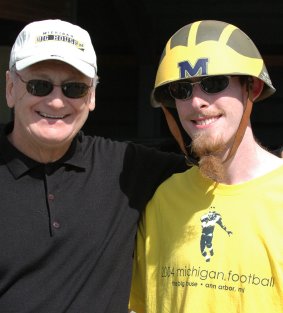
After spring practice one year, I happened to spot him signing autographs and posing for pictures outside the press box. I joined the crowd, and, after a good-natured comment about my lengthy beard, he signed my Michigan-themed army helmet and posed for a picture. It was a brief encounter, but it was one I have not forgotten. I, the self-appointed Sgt. Wolverine, was fortunate enough to meet Bo Schembechler, the great general (retired, but not inactive) of Michigan football. It was a good day.

As that memory mixed with those I was hearing on the radio, tears came to my eyes. I had met him only once, so I knew him only through his immeasurable contributions to Michigan football history; still, the reality of his death brought surprisingly deep emotions to the surface.

It is easy to understand why hundreds of his former players mourn his passing. The endless stories of Bo both as a tough coach and as the most loyal of friends paint a picture of a man who both possessed and taught character and integrity, a man who acted consistently and demanded the same from those around him, and, as such, a man whose passing is rightly and deeply mourned by those who knew him. But I have mourned a man I met only once, a man who coached a team for which I never played, a man whose name is indelibly imprinted upon a university I never attended.

Why do I miss a man I barely knew?

I know I am not alone. On the Tuesday following his death, the university hosted a public celebration of his life; over 10,000 people made the trip to Michigan Stadium to remember Bo. The heart of the crowd was his family, his former players and coaches, and his friends; other coaches from rival schools, like USC’s John Robinson, Michigan State’s George Perles and Ohio State’s Jim Tressel, also came to honor Bo.

But also among those saying one final farewell were those who, like me, might have met him only once, or perhaps never even had the opportunity to meet him — those who know his fingerprints on the Michigan football program far more than they knew him.

Sunday afternoon, two days after Bo’s death, I donned my army helmet and coat and visited Schembechler Hall to see the growing number of tributes in front of the building. Both the collection of items — such as hats, sweatshirts and pictures — and the accompanying messages were touching. Many thanked Bo for his years at Michigan and told him he would be missed; one man left a note that said, “Now my dad has someone to watch UM games with.” As I spent time at the display reading sentiments like that, I found myself crying yet again. This time, I had company.

As I was taking a few pictures, a husband and wife approached the display. With tears in his eyes, he left his own piece of Michigan — a 1997 national championship hat — as his tribute to Bo. He then rejoined his wife, and they stood together for a few minutes, just gazing at the many items left in memory of Bo. They walked slowly past the display, reading the messages, and seemed to be ready to leave. But before they left, he approached me, held out his hand and, in a cracking, unsteady voice, said, “Go Blue.”

We didn’t say much; he told me he had seen me at a few football games, and I showed him the Bo emblem I’d painted on my helmet after I heard the news. That was it. But we didn’t need to say much. We simply stood together for a moment, two strangers who sought no introduction, instead needing only to know that we held a common grief. Neither of us knew the other’s connection with Bo or Michigan football that made us feel a sense of loss; we knew only that we both felt that loss, and that there was something meaningful in those few moments in which we were able to share our grief.

On a larger scale, the gathering at the stadium held similar significance. It was described as a celebration of Bo’s life, but it was not all laughter; there was still room for tears. Current coach Lloyd Carr and former player Jamie Morris both had to pause to fight back tears when they spoke, and Shemy, Bo’s son, broke down several times as he talked. Others in the crowd cried quietly.

It was important not what we did on Tuesday, but that we did it together. We laughed and we cried, and we did so together, an extended family of players, coaches and fans, over 10,000 strong. Many of us did not know him well, but we all were familiar with the football program he commanded for 21 seasons, and that is the thread that brought us together to remember the man we knew or to get to know the man we wish we’d known while he was alive. Whether we had come out of love for Bo or for Michigan football, in the end we had come for much the same reason: Bo and Michigan football are inseparable.

And so we come back to the original question, a question whose answer is actually quite simple. Why do I miss a man I barely knew?

I miss him because I know the legacy he left, and I can see it every time another Michigan football team takes the field. I did not know him, but I know Michigan football; I miss him because Michigan football misses him.

Domestic travel warning

When the U.S. State Department decides a country is too dangerous for American travelers, it issues travel warnings.  For the most part, the list of countries is fairly predictable.

Earlier this week, the University of Michigan took a page from the State Department’s playbook and issued its own travel warning — not for students traveling overseas, but for football fans traveling to Columbus for Saturday’s football game.