A whole new picture … again

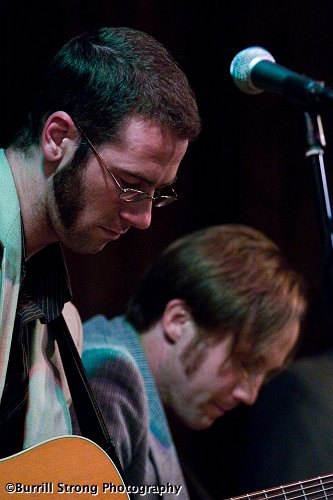
On Friday, I attended a Phil Wickham concert; since I yam what I yam, I just so happened to have my camera in my hand during the show.

The lighting was essentially mood lighting, which is code for “not much”; the show was in a church, and there was no truly useful stage lighting with which to highlight the musician. So when they turned down the lights to achieve the preferred mood, they just made everything dim. In that situation, capturing usable images was a challenge — most concerts are challenges, but this one was even more of a challenge — and the images I did get required more work to take them from usable to worthwhile.

So, as an addition to the recent post concerning my photo processing, here is a before/after example from the Wickham show. (Click on the image to see the larger image.)

As the before image shows, to avoid an impossibly useless shutter speed (musicians are not inanimate objects!), I had to underexpose the images. Fortunately, uncompressed digital images are reasonably robust; after adjustments to the white balance and the exposure (among other things), the image isn’t stunningly award-winning, but it’s considerably improved.

Astute readers may wonder if the above picture is an example of my abandoning my own advice not to simply take a picture and plan to make it good on the computer; in response, I would say, “I never said that! It must have been another blog. Would you like a brownie?”

After the astute readers finished the brownies, I would also say that some situations require compromises in order to achieve a good end product; had I shot the Wickham show at a shutter speed that would have resulted in properly-exposed images, I would have ended up with a pile of blurry unrecognizable messes. I knew that I could work with an underexposed sharp image far more than I could work with a properly-exposed mess, so I made the necessary compromise to produce the sort of images I wanted. I don’t really want to make such compromises, but there are times they simply are not practically avoidable.
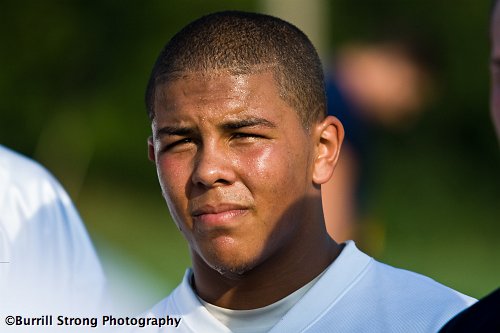
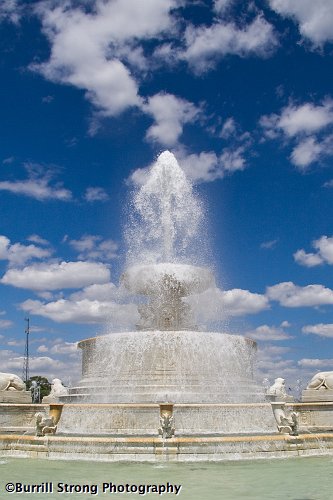
Photo of the Variable Time Period, vol. 112

To be young, gifted and sweaty (18 July 2007).

Chelsea running back Nick Hill takes a break during passing camp. Hill, now a sophomore, made quite an impression his freshman year, breaking into the Bulldogs’ starting varsity lineup just a few games into the season. After showing occasionally dominant physical ability even as a freshman — at times dragging junior and senior defenders down the field, or breaking their tackles altogether — he is entering his sophomore season with high expectations.

(Full passing camp gallery.)

Photo of the Variable Time Period, vol. 111

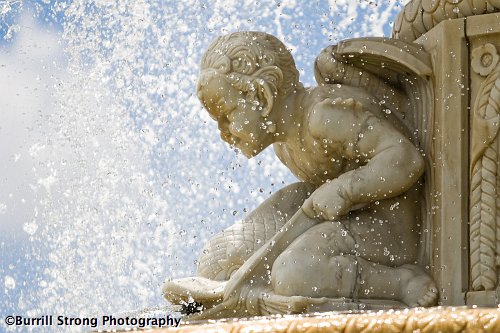
It is a fountain, but it is not of Wayne (01 July 2007).

Not long ago, I found an excuse to take another trip to Belle Isle: though my parents have lived in southeastern Michigan for about 40 years now, they had never visited Belle Isle.  So, two and a half weeks ago, we corrected that oversight.  And since it was a gorgeous day — yes, the sky really was a brilliant blue — I took the opportunity to take a few more pictures.

See the full gallery.

A whole new picture, a dazzling image I never knew

After noting how compliments have changed thanks to nearly flawless photographic alterations in the modern digital world (“Wow! It looks photoshopped!”), I thought it would be worthwhile to show the processing I perform on my photographs.

I maintain a deeply-held dislike for time-consuming post-processing of digital images. This dislike does not spring from a purist’s demand for untouched images; rather, it stems from my own impatience for the process and the details. Some photographers perform a great deal of detailed processing, and some of those photographers achieve stunning results; I do what I can with a relative minimum of processing. It’s a matter of taste, and my tastes run toward not putting an ax through my computer on a weekly basis due to impatience and frustration. Some images take more processing than others, but almost all of them stay below my ax-wielding threshold.

Now, since a picture is worth a thousand words (or 1,043.34 Canadian words), here are three examples of my processing; before is on the left, and after is on the right. (Click on the image to see the larger version.)

First: an image from the Anna Scripps Whitcomb Conservatory on Belle Isle.

The change in this image is fairly obvious, but it didn’t take much to make that change: in addition to my normal adjustments of contrast, vibrance and sharpening, I brought the exposure down. Take a look at my adjustments. (For comparison, see the default settings.)

It is important to point out that if I were a more careful, more thorough photographer, I might have taken the time to get a lot closer to the “after” picture when I was actually shooting. This will be illustrated in the third example.

Second: an image from a recent Chelsea high school football camp.

There isn’t much of a change to this image; the original looked just a little flat and washed out, so in addition to my normal adjustments, I bumped up the Blacks slider just a bit. Unlike the previous image, I did not adjust the exposure. Take a look at my adjustments.

Third: an image from a Great Lakes Myth Society concert.

If you’re having a hard time noticing any significant difference between the before and after images, don’t sue your eye doctor; there really isn’t much of a difference. I did increase the exposure just slightly (in addition to my normal adjustments, of course), but the image was close enough to good that those adjustments made only a very minor difference. Take a look at my adjustments.

For this image, unlike the first image, I was a more careful, more thorough photographer; I took the time to shoot the scene a few times and change the camera’s settings until I finally saw what I wanted. The result? A reduction in necessary processing.

The moral of the story is twofold:

  1. Post-processing is a part of photography, even for those of us who sometimes (oftentimes) wish it weren’t.
  2. More work at the beginning often results in less work at the end.

Wrapped up in the second moral is an important principle for those who are lured by the blithe promises of software advertisements:

  • Don’t just take a picture and plan to make it good on the computer; take a good picture, and use the computer to make it better.

Also, for those of you who might be curious: I use Adobe Lightroom to process my images.

Finally, the detail-oriented might have noticed that I did not adjust the Clarity slider for the last two images. There is a good reason for that: I processed those images before the Lightroom 1.1 update was released, and Lightroom 1.0 did not include the Clarity slider.

Like a surgeon

Years ago, people looked at an altered photograph and said, “Wow!  It looks real!”

Now, people look at an unaltered photograph and say, “Wow!  It looks photoshopped!”

Photo of the Variable Time Period, vol. 110 – Wayward Son Edition

Last weekend, official Mindreader storyteller Andrew and I traveled to Kansas for a wedding. The wedding was in Wichita; since we arrived Friday morning for a Saturday afternoon wedding, we had a bit of time to explore some of the city.

Wichita has made an effort to create an attractive downtown riverfront, and part of that effort is a pair of eye-catching pedestrian bridges serving a city park.

On Sunday, we started making our way up to Lawrence.

At a scenic overlook in the Kansas countryside between Wichita and Topeka, there were signs explaining some of the vegetation. This particular sign made us curious about domesticated wildflowers.

The scenic overlook did provide a pleasant view. And yes, the sky was as gorgeous as it looks. In fact, it was that gorgeous all weekend.

To get to that view, we strayed off the highway, but our original purpose in leaving the highway was not to find that view. Rather, when I was looking at the map, a small town caught my eye.

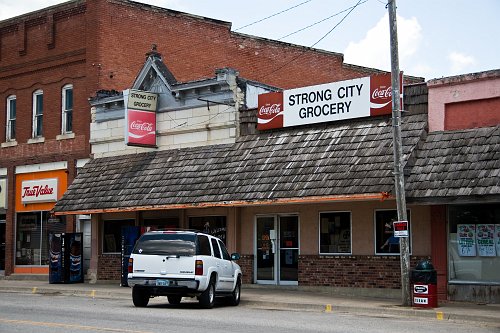
Strong City, a small town southwest of Topeka, is the site of the Flint Hills Rodeo. Its heyday was back when railroads were king, but it is still home for just under 600 people (2000 population: 584).

Its downtown is a classic small town downtown; unfortunately, a number of the storefronts are vacant.

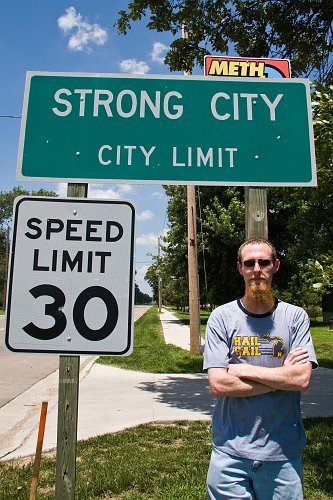
It’s always a joy to find a town that shares my name. (Observant readers will notice that I made an effort to represent my state while I was traveling.)

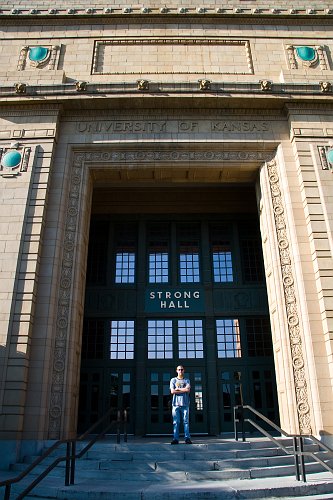
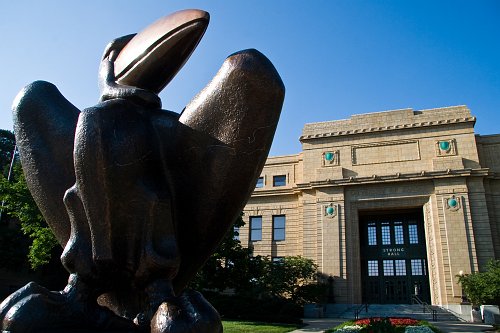
After our brief tour of Strong City, we made our way to Lawrence, the home of Kansas University. When we drove through campus, I was happy to discover that KU has a building that shares my name.

Strong Hall, located in the middle of KU’s campus, is a large building that houses a number of administrative offices. In fact, it is large enough that I suspect Strong Hall has a larger population than Strong City. But obviously, both are equally tastefully named.

Other notable sights:
Kansas Sports Hall of Fame
Knute Rockne Memorial

(Full Kansas gallery.)

When I was your age, I used film

A few years ago, when I was with some of my friends, one posed a thought-provoking question to the group: “What is the best gift you’ve been given?” After a few minutes of thought, I had my answer: my first serious camera.

My first camera was an insufferable digital Polaroid point and shoot with few features and an LCD screen that was unusable in bright environments; my second camera was a Toshiba point and shoot that offered one real improvement over the Polaroid: the screen was usable. But as limited as those cameras were, I do have to give them credit for piquing my interest in photography.

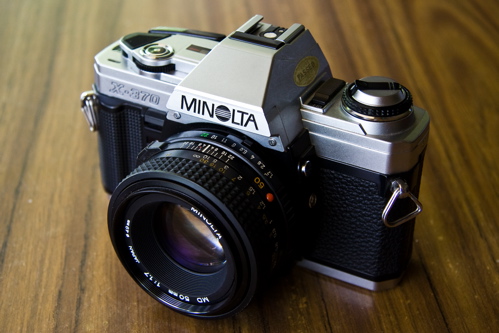
Fortunately, my father took notice of my interest in photography, and he took pity on my point and shoot plight. He had an old camera — a Minolta X-370 — that was lonely, so, in a bit of generosity that now seems prescient, he handed it to me and told me to take good care of it.

Prior to that, practically all my photographic experience was with the small digital point and shoots, so my knowledge of photography was minimal. Modern cameras — particularly point and shoot models — are remarkably simple to use, requiring only the ability to press a button. So, thanks to the thorough helpfulness of such cameras, I knew precious little beyond aiming the camera and pressing the button. And that is one reason my father’s gift was so significant.

The X-370 was a mostly manual camera, so it was a stark contrast to my first two cameras; where those cameras would do all the work for me, the X-370 made me think. It was able to suggest shutter speeds thanks to its light meter, but that was its only helpful feature; the rest was up to me. I could operate the camera simply and with only a little thought, but I knew my progress would be limited unless I learned the fundamentals of photography. So I did just that. Exposure by exposure, roll by roll, that camera helped me learn how to use aperture and shutter speed to my advantage.

The X-370 saw me through a great deal of learning, including a basic photography class at the local community college, and it gave me some images I still rank among my favorites. But change was inevitable; sooner or later, it was bound to become a stepping-stone.

When I began to think of buying another camera, Canon and Nikon were releasing capable and affordable digital SLRs, and they caught my eye. I knew I was going to move back into the digital world sooner or later, and finally, it happened: Canon reeled me in with the release of their Digital Rebel XTi. When I acquired an XTi, I planted both feet firmly in the digital world, and the X-370 once again was retired.

It has been retired for a couple years now, but I still fondly remember the X-370 as the camera that helped me learn photography. And for that, I consider it the best gift I have been given.

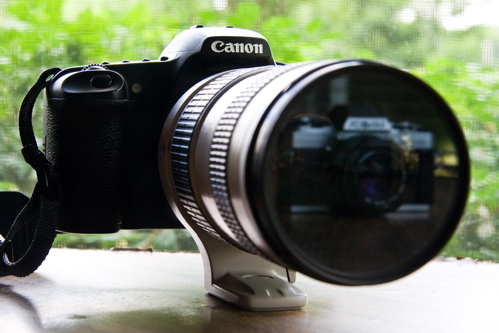
(Some of you may correctly observe that the newer camera in the picture is not an XTi. That is my current primary camera, a Canon 30D. The XTi was busy taking the picture.)

Photo of the Variable Time Period, vol. 107

Big time, bright light (23 June 2007).

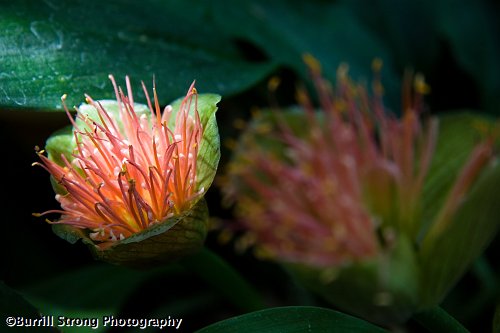
Sunlight highlights a flower in the Anna Scripps Whitcomb Conservatory on Detroit’s Belle Isle.

If you have not visited Belle Isle, I suggest you do so; it makes for an enjoyable day trip. Its main attractions include the conservatory, the marvelous Scott Memorial Fountain, the Dossin Great Lakes Museum, a beach and water slide, a 9-hole golf course and driving range, and even a small zoo. It is a wonderful oasis from the dense urban landscape of Detroit.

And it is my hope that the Friends of Belle Isle Aquarium will someday manage to reopen the island’s aquarium. I was able to visit it before the city shuttered it due to budget problems, and I hope to be able to visit it again.

(Full gallery.)