Underachievement on Ice: the musical

The Red Wings are playing the Coyotes in Phoenix tonight. The Coyotes have been subpar this season; before tonight’s game, they were 25-30-3. That context introduced humor into one piece of music the arena staff chose: during one break in play, they flipped the switch on Switchfoot’s “Meant to Live.”

We were meant to live for so much more
Have we lost ourselves?

Have the Coyotes been that disappointing?

(They lost to the Wings 4-1.  Now they’re 25-31-3.)

Committed like a polygamist to his first wife

A while back, Jerimy Finch, a highly regarded high school football players, committed to play football for Michigan.

commitment [kuh-mit-muhnt]
an agreement or pledge to do something in the future

No, wait. That’s not quite right. He gave his commitment prior to signing day, so he could give only a verbal commitment. And that sounds great … until you realize that while a commitment typically holds some weight among the general population, a football verbal commitment isn’t much of a commitment at all. It’s more of a whim, or a suggestion, or a fleeting thought, like a promise ring in high school. I’ll love you forever, but only until I meet some other hot football program.

verbal commitment [vur-buhl kuh-mit-muhnt]
(college football) a non-binding spoken intent to attend and play football for a specific college or university

That’s more like it. See, after he verbally committed to Michigan, he had second thoughts. His compass turned southwest, towards the Crossroads of America, and he soon fell under the spell of that remarkable football (in other words, basketball) powerhouse, Indiana University.

Fortunately for Finch, he gave not an actual commitment, but a verbal commitment. So he made a call to the best friend of second-thinking athletic high school seniors: the decommitment.

decommitment [di-kuh-mit-muhnt]
(college football) the retraction of a verbal commitment

Having been swayed by Indiana’s fabulous basketball warm-up pants, Finch decommitted from Michigan and told Indiana he’d be traveling their way. But after the decommitment, rumors abounded: he’s sticking with Indiana! No, he’s thinking of coming back to Michigan! No, he’s moving to Tibet to become a Buddhist monk!

After all that, what happened when national signing day rolled around? Why, he signed a letter of intent to play football for the Florida Gators, of course.

So much for commitment.

But I’m not irked at Finch; he only happened to be the ripest target, having been a Michigan commit who changed his mind twice.  Ultimately, my problem is not with him, or with any other recruit; instead, it is with the misleading “verbal commitment” that abounds in college football.  If a recruit decides not to attend one school or another, that’s fine; however, I would rather not see any sort of commitment enter the picture until that recruit is ready to be held to that commitment in some way.

The amazing race

Martez Wilson, a top defensive end who recently committed to the University of Illinois, explained the impression he got from Illinois coach Ron Zook:

“When he first started recruiting me, it felt like I was family to him already,” Wilson said at a press conference to announce his commitment. “I felt he was no uptight white coach.”

The terrible ‘tudes, again

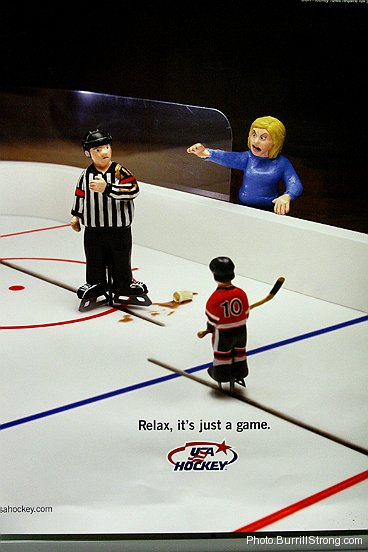
Not long ago, as I was waiting for a local high school hockey game to begin, I was listening to a conversation among three hockey dads. Much of the conversation was centered around one dad’s actions following his son’s team’s previous game.

During the game, a referee called a penalty, apparently because of the language of one of the players. This dad took such exception to the call that he made a point to catch up to the referee after the game to tell him exactly what he thought of that call. Judging from his tone and attitude in recounting the incident, it is unlikely that his comments to the referee were calm and constructive.

Based on the dad’s narrative, he told the referee that he shouldn’t react so strongly to such language, that he should “grow some skin” (a phrase he used more than once as he recalled the encounter), that it wasn’t directed at him, that these are 16-, 17- and 18-year-old boys, and that they’re just going to use those kinds of words. The referee, probably irked by his confrontational attitude, told the dad that he could referee these games for $40 a game; the dad retorted, “For $40 a game, you could grow some skin.”

All the while, just across the room, a poster from USA Hockey was begging to be noticed:

Oh my Lloyd

Ronald Bellamy’s Underachieving All-Stars is an eloquent blog focused on Michigan football. It is not the typical litany of game analyses and recruiting rumors; it is, primarily, the innermost emotions and thoughts of a passionate fan.

Yesterday — appropriately, a Sunday — he posted an intriguing entry pondering the religion of sports. I don’t know that he and I share beliefs, but his comments are thought-provoking and thus worth reading.

I had never taken much time to consider something like this before. Too many communion wafers, too much Sunday school, too many prayers, maybe. But something happened after the Title Game that made me wonder. The game had been over for a few hours, and someone on an Ohio State fan forum had written, “please god, let Ginn and Gonzalez come back.” That is precisely the way it was written – the names of the two players appropriately capitalized, while the man who he pleaded with was irreverently lumped together with other gods, gods as if by profession, whose duty it is to right the wrongs in our sacred pastime. In this case, in the case of college football, it was Ginn and Gonzalez who were divine; the anonymous god was simply the man handing out rosary beads from a kiosk.

Proportion thing

Recently, I attended a Chelsea basketball game.  The Bulldogs fell behind early, but they made a late comeback and fell just short of winning the game.  It was a fun finish.

Sadly, the opposing coach was a bit less fun.  Throughout the game, he had no qualms about being vocally negative, both toward the officials and toward his own players.  At one point, when his team was whistled for a foul on a Chelsea shot shortly after no fouls were called during a physical sequence on the other end of the court, he informed the officials of the depth of their poor judgment.  After he expressed his opinion to the officials, he made one comment, ostensibly to himself but audible to many in the vicinity: “Only in Chelsea.”  That was all too representative of his general attitude and behavior.

I have failed to mention an important detail: it wasn’t a varsity game; it wasn’t a JV game; it wasn’t even a freshman game.  In fact, it was an eighth grade boys basketball game.

Is that really what eighth-grade boys should see in their coach?

Burninating the Southeastern Conference

Last week, I photographed a Dexter High School hockey game.  As I was waiting for the game to begin, I noticed Dexter’s logo on the arena wall.  Dexter’s mascot is the Dreadnought, so, logically, their logo is a cartoony ship.

Both my father and I noticed two curiosities in the logo: first, it seems to be sinking; second, the placement of the arms is odd.  (I likened it to a person having one arm in its normal location and the other on his hip.)

Later, others viewed that photo of the Dexter logo, and one person made an observation I couldn’t believe I’d missed.

Over on the fun Homestar Runner site, there is a popular feature called Strongbad Emails.  One of the emails features Trogdor, a dragon drawn by Strongbad, and one of the site’s most popular characters.

Upon viewing the Dexter logo, that observant person noted that the muscular arms on Trogdor look very much like those on the Dexter logo.

In light of that similarity, I think it’s time Dexter changed its mascot.  Make some noise for the Dexter Burninators!

Bonus curiosity:
The logo features the proper historical spelling — Dreadnoughts — but as demonstrated by the local newspaper, Dexter’s sports teams are now called the Dreadnaughts.

Like a school on break

Nick Saban recently left the Miami Dolphins for the head coaching job at Alabama.  To inform his staff and his players of his departure, he didn’t meet with them personally; he made a speakerphone call to his staff members, and he sent an email to his players.

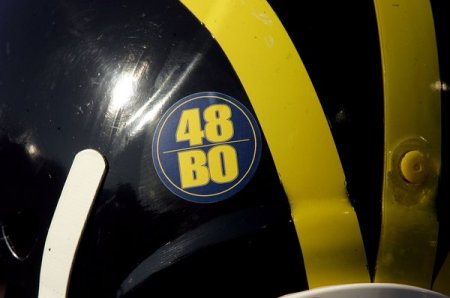
In contrast, consider Bo Schembechler.  At Bo’s memorial service at Michigan Stadium, Lloyd Carr spoke of the time Bo received a very lucrative offer from Texas A&M; the Aggies wanted him badly enough that they offered to make him the highest-paid coach in the country.  He met with his assistants and asked each for his opinion on the offer.  After a somewhat divided response from his staff, Bo looked at them and, with a tear in his eye and a cracking voice, said, “Yes, but you don’t have to tell those players you’re leaving.”

Hail to the chiefs

It’s been a tough year: the Michigan football program suffered two major losses this season.  No, not the games against Ohio State and USC; those were just football games.

Former coach Bo Schembechler and former team captain and MVP Gerald Ford died during this football season.  Schembechler became the face of Michigan football; Ford became president of the United States.

Michigan football is fortunate to have two such figures in its history.

The terrible ‘tudes

This year’s Rose Bowl featured two asinine displays of classlessness on the field. Surprisingly, neither act drew a flag.

  • In the second half, Southern Cal receiver Dwayne Jarrett caught a pass and streaked down the field for a touchdown. As he neared the end zone, Jarrett looked at the nearest Michigan defender and pointed at him. The taunt, normally an almost automatic penalty in the college game, failed to draw a flag.
  • Later in the game, Jarrett caught a pass for a first down. He sat up and dropped the ball in the lap of the Michigan defender sitting next to him. Again, there was no penalty.

(There also was a derivative end zone celebration that failed to draw a flag, but that seems to attract less attention these days; it’s harder to consider that a likely penalty now.)

Unfortunately, those incidents are representative of football culture. Also unfortunately, they are better for television’s demand for entertainment than they are for the game of football itself.

It’s worth noting that even the TV analysts were becoming irked by the actions of some of the USC players; they began wondering why the officials weren’t calling the penalties. It was a fine example of talking heads criticizing the result of their own medium.

Ah, well. It is apparent that one question was answered by Jarrett’s actions in the Rose Bowl. Forget his body and his work ethic: without a doubt, Jarrett’s attitude is ready to jump to the NFL.