Burrill's Blog

Photography in Chelsea, MI

Menu

Skip to content
  • Home
  • Burrill Strong Photography
  • Note Cards
  • Prints
  • Shirts

Categories

Archives

Author Archives

sgtwolvehttp://blog.burrillstrong.com/

Photo of the Variable Time Period, vol. 42

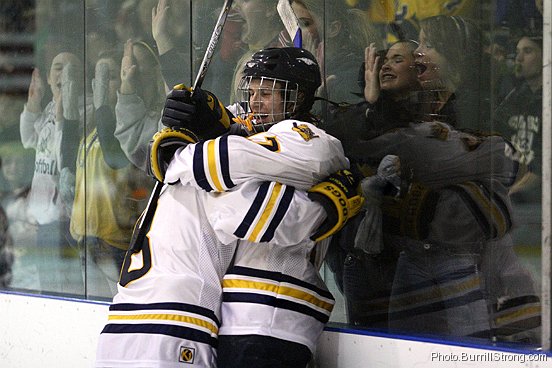
I love you, too (09 December 2006).
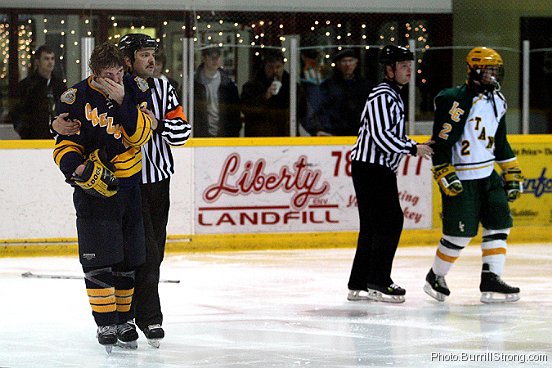
As both players are escorted off the ice, Chelsea’s Schyler Williams checks for injuries after absorbing several punches from a Jackson Lumen Christi player.  Both players were ejected; Chelsea left with a 5-3 victory.
December 11, 2006 by sgtwolve Posted in Photos

Photo of the Variable Time Period, vol. 41

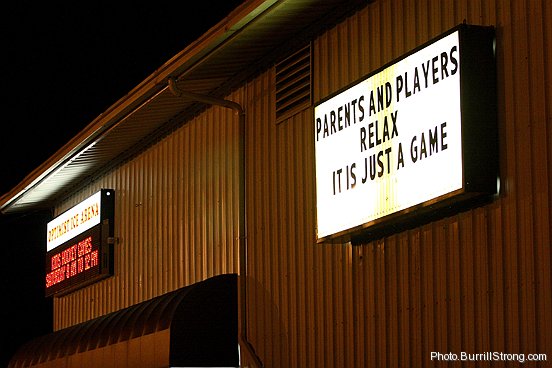
Keep trying (10 December 2006).

As Chelsea met Jackson Lumen Christi in a hockey game, Optimist Ice Arena made a plea for perspective. Despite the call for responsible behavior, the game featured multiple player ejections. Chelsea left with a 5-3 victory.
December 10, 2006 by sgtwolve Posted in Photos 1 Comment

Photo of the Variable Time Period, vol. 40

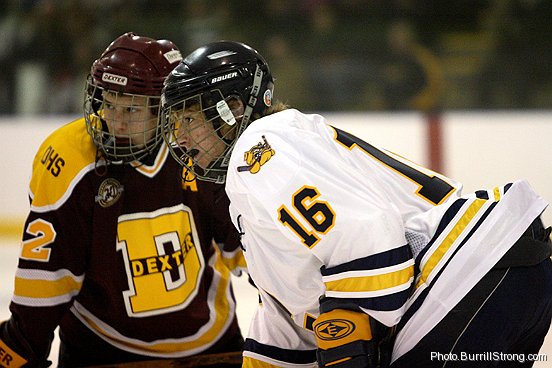
So happy together (29 November 2006).

Chelsea’s Garrett Nickels and his Dexter counterpart wait for the action to start again.  The Dreadnaughts beat the Bulldogs in the first of two games between the rivals this season.

December 9, 2006 by sgtwolve Posted in Photos

On sale now!

Just off the highway near the Michigan/Indiana border, there is a Big Lots.  This Big Lots location, like the many other locations, is probably a wonderful store; however, when I drove past the store last week, something wasn’t right.

As with any big box retail store, the front of their building features large individually-lit letters spelling out their store name.  It is important that the letters are individually lit because I drove past the store at night, and one letter happened to be dark.  That letter happened to be the L, which means the store was boldly proclaiming this advertisement to the area:

“BIG OTS”

One wonders what exactly they sell at such a store — or who they allow inside.

(I was unable to get a picture of the store, so you’ll have to take my word for it.  Also, if the humor is unclear, read it without the space.)

December 8, 2006 by sgtwolve Posted in Fun

07 December

Remember this day in 1941.  Remember the attack on Battleship Row, on ships such as the West Virginia, the Shaw, and the Arizona.  And remember those who were there.

(The pictures are from the Naval Historical Center.)

December 7, 2006 by sgtwolve Posted in News

College football: old and improved

There is controversy in the BCS. Again.

Second-ranked USC, the team most assumed would be playing Ohio State in the postseason, lost to UCLA; fourth-ranked Florida beat Arkansas in the SEC conference championship. Third-ranked Michigan, the team that many analysts initially decided was better than Florida even after losing, finished its season two weeks earlier. But despite Michigan’s being idle, and despite Florida’s failure to use its last two games to assert itself as superior to Michigan — particularly in an anemic effort against unranked Florida State — the Gators passed the Wolverines in the final poll.

Many explanations for the position switch held to one of several common themes: Florida won its conference; Florida plays in the top-ranked conference; the nation doesn’t want to see a Michigan/Ohio State rematch. The validity of those explanations within the confines of the BCS is being debated, and that debate is fueling yet another round of suggestions for fixing the BCS. All of those suggestions have one thing in common.

They are destined to fail.

The apparent purpose of the BCS is to match the top two teams in the nation in order to determine a national champion; more often than not in its short but turbulent history, it has succeeded most often in fueling controversy over the exclusion of at least one seemingly deserving team. Be it undefeated Auburn’s exclusion or Texas’ passing an idle Cal after an underwhelming victory, the BCS has created more questions than it has answered. In the process, it has taught important lessons about college football.

Or perhaps more accurately, it has tried to teach important lessons. Sadly, as demonstrated by the growing push for a playoff system, few seem to be learning anything from the failures of a national system in a regional game — failures which show us that to fix college football, we need to rethink our focus and take a few steps backwards to when it wasn’t broken.

After a so-called split national championship between Michigan and Nebraska in 1997 — something that was really a difference of opinion given too much absolute credibility by fans and sportswriters — the crusade to name a champion began. The basic idea of the new system, the BCS, was to match the top two teams in a bowl game to produce a true number one team. But while it was fine on paper, it turned out to be startlingly naive once it was introduced to the unique landscape of college football.

Because the structure of college football did not actually change with the introduction of the BCS, the system often struggled to produce a top two without controversy. Quite often, there were not only two top teams; since college football’s structure provided no reliable method of separating closely-ranked teams, the BCS had no way to relegate a third team that could just as easily be the second team. Its flaws were never clearer than in 2003, when it produced its own split championship.

The constant controversy surrounding the BCS has given strength to the push for a playoff system in college football. The proposed systems vary, but all are built with the idea that they will produce a true national champion, succeeding where the BCS failed. These playoff systems have something in common with the myriad of proposed BCS fixes.

They, too, are destined to fail; college football is not built to produce a national champion.

A system can’t escape the league it presumes to judge; just like the BCS, a playoff system would find itself struggling with the challenge of ranking teams across college football’s regionally compartmentalized structure. To fill its brackets, a playoff system would be forced to rely on a set of criteria no more reliable than that of the BCS; thus, just like the BCS, a playoff system would find itself producing controversy because of the unreliability of the rankings supporting the system.

In that light, the solutions themselves are a problem: they ignore the established structure of the league. They attempt to create an absolute national finality that is not compatible with the regional nature of college football. A system should not seek to shape the league around itself, but instead should shape itself around the league; the recent championship systems make the mistake of considering themselves bigger than college football.

These problems stem from a growing focus on producing an undisputed college football national champion. The constant drone from preseason through the final week centers around the teams that have a chance of earning a berth in the BCS championship game, and those that finish just outside the top two are conditioned to be disappointed. Top teams are supposed to have the BCS championship as a major goal. That goal is now the most-hyped element of the sport; it is also a harmful assault on college football.

This single national emphasis strikes at the strongest underpinnings of college football: the conferences. College football as a whole is marginally unified under the NCAA, but its strength has long been in the individual conferences; the sport is at its best when the primary focus of a team is its own conference, and not the national picture.

Under college football’s old two-poll system, that focus was easier to maintain. Teams worked to win their conferences and to represent those conferences in the bowl games that were the destination for conference champions; there were two sets of national rankings, but no bowl berths were dependent on those rankings. Neither set of rankings proposed to crown an undisputed national champion; each named its own champion. The polls asserted nothing more than opinions.

The establishment of the polls as opinions rather than absolute judgments made the two-poll system far superior to both the BCS and the proposed playoff systems. Opinions are flexible and fallible, so the polls functioned well within the existing framework of college football. The BCS’ struggles with the regionalized nature of the sport were not true struggles for the old system: the two polls did not face the challenge of accurately comparing two schools with two entirely separate schedules, nor did they bear the pressure of choosing any bowl berths. They simply ranked the teams as they saw fit, and, since the poll rankings did not dictate traditional bowl matchups, any controversy caused by the rankings stayed off the field — a crucial distinction from the newer systems.

The old system didn’t discard championships; it just kept them at a regional level. Throughout the old two-poll system, and now through the BCS hullabaloo and playoff proposals, the conferences have maintained their own championship system with a minimum of controversy and with great success. Unlike national championship systems, year in and year out, the conferences provide the environment necessary to produce genuine champions.

While three different conferences — and thus three completely different conference schedules — are represented in this year’s top four BCS teams, only one conference is represented in the top four teams in any conference. While those three BCS teams share very minimal schedule overlap, each team in a conference has substantial overlap with every other team. While none of those three BCS teams faced each other during the season, each team within a conference plays nearly every other team. When a national system such as the BCS seeks to rank similar teams and settle the inevitable disputes, it faces a speculative challenge; when a conference seeks to rank teams, it has an abundance of overlapping data with which to compare teams and more than enough credible tiebreakers to accurately rank teams.

In the current frenzy for a college football champion, we in the sports world seems to have forgotten about conference championships. We seem to have forgotten that college football once knew how to distinguish the difference between genuine championships and crowns of opinion. We seem to have forgotten that college football still knows how to crown credible champions. We also seem oblivious to the problems inherent in forcing national results on a regional sport.

With another BCS controversy threatening yet again to topple the system and with playoff proponents growing louder every year, the old system is quickly fading into oblivion as a national championship becomes the only prize that matters. And with every new system and its requisite controversies, we seem less willing to consider this simple idea: maybe college football wasn’t the problem.

Maybe we lost our focus on its strengths and started pursuing something it can’t give us. Maybe we tried to fix a nonexistent problem — or maybe we were the problem.  Maybe we should stop looking forward and start looking back.  Maybe we had it right; maybe we can have it right again.

Maybe we broke college football with our solutions; maybe it’s time we solved those solutions.  All of them.

December 6, 2006 by sgtwolve Posted in Commentary, Sports 36 Comments

Photo of the Variable Time Period, vol. 39

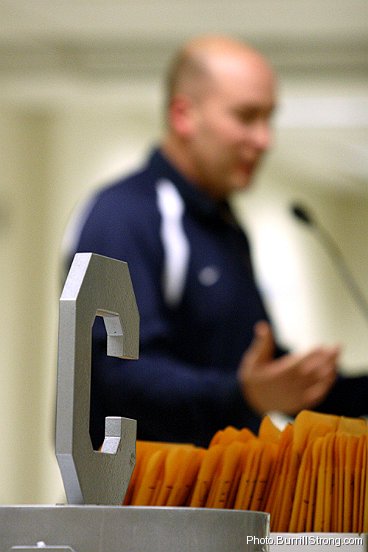
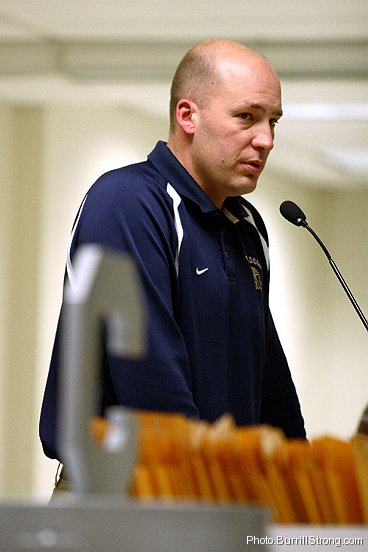
Now you C him (04 December 2006).

Chelsea football coach Brad Bush talks to the football family at the varsity’s year-end gathering. In the foreground is the Iron Dawg Award, an award for weight room work ethic.

December 5, 2006 by sgtwolve Posted in Photos

Separated way before birth

Like any respectable professional sports venue, Joe Louis Arena provides a nearly endless supply of alcohol to fans; typically, this results in a number of drunk fans by the end of the game. On Saturday, I attended a Red Wings game at JLA, and it was no exception.

After the game, I happened to be walking next to a drunk fan. He noticed my Michigan army helmet and my prominent limp, and after some conversation about the BCS standings — a hot topic of conversation after UCLA’s defeat of USC — he looked at me and exclaimed, “Hey! Are you that guy from Last Comic Standing?”

Not wanting to admit that I’d never even seen the show, I simply told him that I was not that guy. However, he kept insisting that I looked just like him. In fact, he even pointed me out to the woman behind him, and she, too, thought I was that guy.

Upon arriving home, I found the site for the show; it didn’t take long to find the comedian they had referenced. Thanks to our similarly prominent facial hair, the drunk Red Wings fans decided that I look just like Josh Blue.

Also, I quickly discovered two fascinating facts:

  1. Josh Blue and I both have CP. That probably aided the resemblance. Apparently he and I walk somewhat alike, too.
  2. I don’t look and walk a bit like just any comedian on Last Comic Standing. I actually look and walk like the winner of the show.

Having said all that, I won’t leave this up to your imagination. Here’s a side-by-side comparison.


December 4, 2006 by sgtwolve Posted in Fun 2 Comments

Watch out for the highly-destructive 5mph wind, too

From a Lawrence (KS) Journal-World story about a snowstorm that did not live up to forecasters’ expectations:

After doomsday predictions earlier this week of multiple inches of snow piling on the Lawrence area, the heart of the city received only a brief dusting after sundown Thursday.

It is always fascinating for me to see “multiple inches of snow” become an emergency situation.  But the local Detroit news broadcasts enjoy hyping the chance of a few inches of snow, too, so I suppose it’s a widespread occurrence.  Where there is TV, there must be overreactions.

December 1, 2006 by sgtwolve Posted in Uncategorized

Photo of the Variable Time Period, vol. 38

Come on, get happy (29 November 2006).

Chelsea’s Schyler Williams (#17) celebrates in front of his fellow students after his second-period goal against Dexter.  The Bulldogs lost 4-2.

November 30, 2006 by sgtwolve Posted in Photos

Post navigation

← Older posts
Newer posts →
Proudly powered by WordPress Theme: Stitch by Caroline Moore.