A series of five images, actually.
Company’s Coming (07 October 2006).
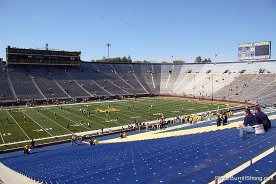
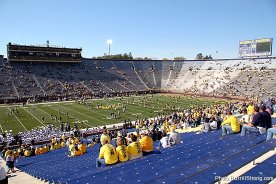
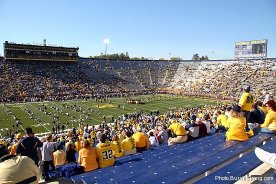
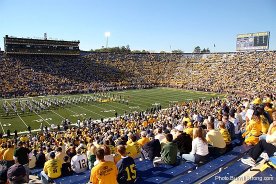
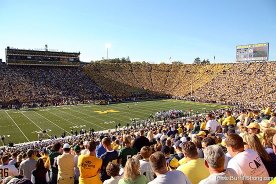

A series of five images, actually.
Company’s Coming (07 October 2006).
Flag of our Students (07 October 2006).
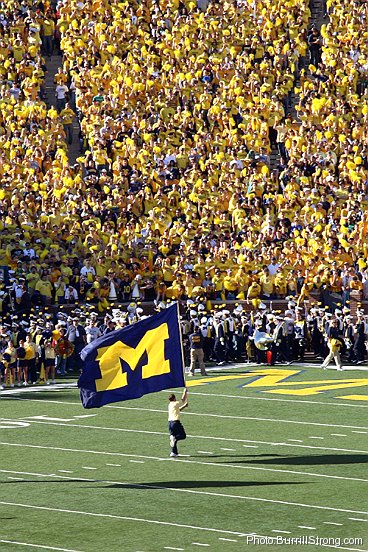
The Lions/Vikings/Twins crisis has been averted: the Twins helpfully lost their series with the A’s. In fact, they got swept. The Lions should thank the Twins for being so kind as to avoid extending the series beyond the minimum necessary games.
But the problems with facility sharing still exist. Major sports should not share a venue.
The Free Press explained the absurd situation of the Lions due to the potential Vikings/Twins schedule conflict:
If the A’s complete a sweep of the Twins, the Lions will fly to Minnesota on Saturday and play the Vikings on Sunday as scheduled. No big deal.
But if the Twins win, that forces a Game 4 on Saturday — and puts the Lions at a distinct disadvantage. While the Vikings relax at home and wait to see when they’re playing, the Lions must come to team headquarters in Allen Park ready for three scenarios Saturday night:
• If the A’s win Game 4, the Lions will head right to the airport, fly to Minnesota and play the Vikings on Sunday.
• If the Twins win Game 4, the Lions will go home, sleep in their own beds, fly to Minnesota on Sunday and play the Vikings on Monday night.
• If Game 4 goes to deep into extra innings or is delayed by rain, earthquake or goodness-knows-what, the Lions will go to the airport and fly to Minnesota still uncertain of the situation. If the A’s win, they will play Sunday. If the Twins win, they will work out at the University of Minnesota and sit around until Monday night.
In major professional sports, this should not happen. But when it does happen, the “home” team should have to endure the inconvenience of preparing to play its home game somewhere else. If they can’t be sure of providing a home field for the originally scheduled date and time, then they, not the visitors, should face the consequences.
1)The victim was airlifted to the nearest OfficeMax for emergency treatment
Lawrence, KS seems to be an odd town. Small-town police blotters tend to be amusing; Lawrence proved that larger towns can be funny, too. From the 04 October blotter:
“Lawrence police responded to the 100 block of Indian Avenue around 3:40 p.m. Tuesday after a 22-year-old Lawrence man allegedly hit another man in the head with a metal tape dispenser.
“The man was eventually arrested on suspicion of aggravated battery.”
Officers at the scene said the victim was fortunate his assailant was not carrying a loaded stapler.
They expect to have no problems making the charges stick, since the whole event was caught on tape.
2)Also, it’s great for grilling at a tailgate
There is a new vehicle anti-theft device in South Africa: a flamethrower. It produces a fireball tall enough to engulf any thief … yet it is neither damaging to a car’s paint nor lethal to humans. Apparently it simply blinds the would-be car thief. And it’s only around $650. And “it has yet to be deemed illegal.”
The bad news? It doesn’t shoot flames out the back of the car to convince impatient drivers to back off.
Last Saturday, I had the opportunity to experience a Notre Dame football gameday; I watched them play Purdue. Without a doubt, it is a worthwhile experience for any college football fan. And I say this as a staunch Michigan fan.
The highlights, with pictures:
As with any good football program, tailgaters were out in full force before the game. Many like to raise flags to let you know their loyalties; one of the notable non-football displays belonged to a group of firefighters.
Beanbag toss seems to be some sort of a Notre Dame tailgate tradition; we spotted a number of tailgaters who brought a beanbag toss as a part of their setup.
One of the particularly fun ND traditions is the players’ walk to the stadium. The route is completely lined with people, and the players, all well-dressed in suits, walk through the human tunnel to the stadium; even the mighty Brady Quinn participates. Naturally, there are numerous cameras recording the event.
Those who have seen the movie “Rudy” may recognize the place he lit candles as he petitioned for acceptance to ND; the Grotto is quite a popular place before games.
The ND band also marches across campus to the stadium, and like the players’ walk, it attracts crowds. I love a good college marching band, so that’s fun to see.
Some ND fans are also big fans of Zaccheus, but with a father as the tree.
The team’s entrance into the stadium is fantastic, with the crowd roaring as the players run through a big ND formed by the band.
The Leprechaun is insane. He must be sponsored by every energy drink on the market. He dances and prances the entire game. I can’t imagine the amount of energy he requires for one game. I don’t know how he does it. But really, if a team has to have a mascot — I am a fan of Michigan’s lack of mascot — he’s as good as there is. Partly because he’s not in some big goofy animal suit or with some giant head (think Ohio State), and partly because he’s fun to watch.
ND’s academic reputation was upheld as the cheerleaders demonstrated their ability to spell. I wonder if Navy’s cheerleaders try to spell anything during games…
I was fortunate enough to be able to watch the game with the students. Typically, the student section is the most energetic part of any crowd, and ND’s students are no exception. As usual, they have a number of well-loved chants, cheers and traditions, most of which were simple enough to pick up fairly quickly.
At the end of the game, win or lose, the band and the players gather in the corner of the field and serenade the students. I happen to be very fond of that sort of tradition, though you wouldn’t know it, since, for photographic purposes, I had my back to the scene. (I really do like that sort of tradition. That’s why it was a good time for a picture.)
Some students were wearing one of the most amusing shirts I’ve seen. I could get a shot only of the back of the shirt, but you can see both sides and buy it online.
The landmark of ND’s campus is still as landmarky as ever.
Most of my pictures are referenced here, but if you want, you can visit the full gallery.
Non-photographic thoughts:
Notre Dame was wise to build the stadium on campus. It was fun to walk around campus and see the whole place full of fans. Places like Michigan, where the stadium is separated, have a different atmosphere, since it’s spread through city streets. Not an inferior atmosphere; just different.
There are numerous student groups that sell bratwursts and burgers all over campus; they all get the meat from the same place, and it’s all excellent. If you are there for a game, buy food from a student group.
In the arena next to the stadium, they have a variety of activities and gatherings. One notable feature is the 360-degree photograph of the stadium from midfield just before kickoff. It’s actually slightly disorienting to stand in the middle of the picture, but it’s also very cool.
The stadium itself is sparsely adorned both inside and out, and it’s very pleasant. I spotted only one small advertisement in the stadium, and it was for NBC, the network that televises ND football games. However, I was surprised to find that there are no video boards in the stadium. Just old-school scoreboards. I wonder if they will ever add video boards.
Coming from regular experiences in Michigan Stadium, the stadium actually felt a little bit small when I first entered. Given the difference in capacity, that was not a surprise. But by the time I left, it felt plenty big.
Notre Dame’s student ticket policy is a bit … dictatorial, shall we say. Again, my previous experience was with Michigan student tickets. Michigan requires student I.D. to accompany a student ticket, but any student can use any student ticket. Any student ticket can be validated for general use by any student, with the only limitation being the number of tickets one student can validate each week. On the other hand, Notre Dame ties each student ticket to one specific student; the tickets bear that student’s name, and he must show photo I.D. to enter the stadium. Students can transfer a ticket to a non-student, but a student can transfer only so many tickets per year, and there is a hard cap on the total number of student tickets that can be transferred each game. The student must transfer it to a specific person, and that person must show picture I.D. to enter the stadium. Personally, I think the policy is a bit heavy-handed, but as long as they fill the stadium, it won’t change. Plus, it makes me feel much better about Michigan’s student ticket policy. I used to gripe about the relatively new I.D. requirement, but now I’m perfectly happy with Michigan’s policy.
In the middle of the game, it rained. It was good. I like rainy games. Later in the game, a police officer got on the P.A. system and started talking about traffic safety. I was informed that he does this for each game, and he always manages to get a laugh out of the crowd. It seems to be a popular feature of the game. For the Purdue game, he concluded his comments by saying, “Remember, don’t drive like an animal when it’s raining cats and dogs.” That’s quality humor. Seriously.
Last Wednesday was the student count day in Michigan, the first of two days on which the public schools count their students to determine the amount of state money they receive. (The first, in September, determines 75%; the second, in February, determines 25%.) Normally this isn’t a major news story; most people don’t pay too much attention to count day. But the dismal financial condition of the Detroit Public Schools, the prolonged teacher strike, and the resulting drop in student enrollment made count day a top story for Detroit news outlets.
The news stories preceding count day were dominated by gloomy estimates that the schools had lost some 25,000 students — a precipitous drop compared to the previous estimates of 9,000. Officials cautioned that it was early, and that the numbers were not yet complete, but the number made for good headlines.
In the shadow of such dire proclamations, Detroit made every effort to lure as many students to school on Wednesday, turning schools into small carnivals with free food, face painting and raffles featuring prizes such as backpacks, laptop computers and lunch with a rapper. However, the early numbers suggested only mixed success from the attendance blitz; some schools gained enrollment, others lost, and the best estimates still left the district with a loss of 19,000 students.
Detroit’s count day hysterics illustrate a problem with the concept of setting a school’s funding based on two days. The problems are simple: two days is only a small fraction of the full school year, and the schools know the days their enrollment affects their finances.
Limiting count day to only two days, and particularly to only one day at a time, allows desperate districts to push to artificially pad their numbers through decidedly non-educational means — essentially the enrollment version of teaching to the test. A school that knows its numbers are declining can make gaudy efforts to limit their losses by attracting students whose state funding stays in the district for a while, even if the student doesn’t stay; in Detroit’s case, the district appealed to students through parties and giveaways. Even if the schools are not so calloused as to make no effort to retain students — I am not cynical enough to believe there are that many administrators who would actually do so — someone has to realize that at least some of the students who come for the iPods, laptops and lunches with rappers aren’t going to stick around for much education.
This contrasts with the free-market principles displayed in private schools; in an online Detroit News editorial, Manny Lopez noted, “The parochial and private schools already get it. Everyday is Count Day for them. If they don’t deliver a safe, quality education, their customers leave.” But public schools can retain some level of state funding by artificially boosting attendance two days a year, even if some of those students attend only infrequently the rest of the year. In a sense, they can receive nearly full-time pay for part-time students, if those students are part-time at the right times.
To avoid letting temporary students have a hand in state funding, perhaps a better solution would be to expand and mystify count day. Instead of using only two well-publicized days to set enrollment, perhaps the count could be taken from more days over a longer time period.
One possibility would be to use counts from ten days over six weeks, and without publicizing the dates being counted. This would serve two purposes: it would provide a more accurate picture of a district’s typical population, and it would prevent declining or money-hungry districts from staging count day hysterics to pad enrollment. One unusual day, good or bad, would neither hurt healthy districts nor help ailing districts; the former would not be hurt by one below-average day, and the latter could not improve their finances with transient students.
State funding for public schools should be immune to enrollment exaggeration; if a school does not retain students, then it should not retain state funding. The state ought to rewrite the count day policy to compel schools to focus on consistent attendance rather than iPod-driven rental students.
Last week there was an odd story out of Lawrence, KS.
Someone stole 16 soccer nets from a youth sports complex; no one could explain the motivation for the theft, since the market for cheap used soccer nets isn’t exactly thriving. Amidst the resulting uproar, as the association scrambled to replace them in time for the weekend’s games, all 16 soccer nets mysteriously reappeared in a garbage bag on the front lawn of the association’s equipment coordinator. With the nets was an envelope containing $50 and an apology:
“I’m sorry. I intended to return these from the start. I didn’t know the complications that would follow. Please accept this $50 donation for repairs.”
On Sunday, the Lions will play the Vikings in Minnesota … maybe. Or it could be Monday. I’d tell you when they’re playing, except nobody actually knows yet. They have to see if the Twins’ playoff series lasts through Sunday.
Can you believe this is happening in the money-soaked world of professional and major-college sports?
This problem is nothing new in the Twin Cities. For years, the Vikings (NFL), Twins (MLB) and University of Minnesota (college football) have occupied the same space in the Metrodome. For much of the year, this causes no problems; only the Twins have games in the spring and early summer. But then come late summer and early fall, and with that time period comes the struggle to fit multiple teams — more specifically, multiple sports — into one facility.
Really, the conflicts are infrequent; since football games occur only once a week, there are only two potential conflicts each week: college football on Saturday and the NFL on Sunday or Monday. But when another conflict occurs, it is yet another reminder that two different high-profile sports do not belong in the same facility.
As noted at the beginning of this post, the most recent problem is an NFL/MLB collision. The Vikings are scheduled to play Sunday at 1 p.m. But if the Twins/A’s series extends the full five games, the Twins will have priority over the Vikings, and the football game will move to 8:30 p.m. Monday.
To the best of my knowledge, The Twins vs. A’s/Vikings vs. Lions conflict is one of a few issues in the last year. The previous Saturday, a Twins regular season game included the stipulation that no inning could begin after 3:00 p.m.; any remaining innings would be postponed until Sunday. The time restriction was instituted so the Metrodome’s grounds crew would have sufficient time to change the baseball field to a football field for the University of Minnesota’s 8:00 p.m. game against Michigan. Fortunately for the Twins, the game did not run past 3:00.
However, the last time Michigan visited Minnesota, the situation was not so easily resolved. The Twins were in the playoffs, and as is the case now, they had a potential playoff game on Saturday. The Twins had priority over the Gophers, and after unsuccessful attempts to make arrangements to play the game on Saturday, the university moved the football game to Friday night — a move I will never condone.
None of these situations should have occurred; it is absurd for two different high-profile sports to share a facility. The Vikings and Twins both belong to massively popular, extraordinarily wealthy professional sports leagues, while the University of Minnesota belongs to one of the top football conferences in the nation; there is no reason these teams should not have their own facilities.
Fortunately, this situation is on its way to being resolved; both the Twins and UM are working towards separate facilities — in UM’s case, on-campus facilities. (Finally.) But, in the meantime, and for any other teams operating under similar circumstances, the homeless home team should make every effort not to reschedule the game, even if it is to its own disadvantage and to the detriment of its home-field advantage. Facility conflicts are not the fault of the visiting team, and it seems unfair to move the game to another day simply because the home team doesn’t have its own home field.
On Sunday, the Stronghold hosted a hayride and cookout. As usual, the cookout was supplemented by 2-liters of carbonated beverages; as usual, the beverage pattern of American cookout history was sustained.
My experiences with cookouts and other gatherings are fairly consistent: someone who does not like regular carbonated beverages believes that there are many others who feel the same way; this results in the misguided purchase and unfortunate donation of beverages such as Diet Coke. Sunday was no exception. Someone stubbornly ignored the abundant lessons of American cookout history and brought Diet Coke and caffeine-free Diet Coke; as usual, those two comprised the majority of the beverages the crowd did not finish. When the guests departed, we were left with three 2-liters of carbonated beverages:
Even though the relevant orphaned beverages are curiously distasteful “diet” beverages, it is still a waste of perfectly good carbonation. So, in the spirit of carbonation conservation, this fresh confirmation of the popular disdain for diet beverages at social gatherings leads me to propose a new rule. Let’s call it the:
No Aftertaste Left Behind Declaration
If at any time in your life you are asked to contribute carbonated beverages to a social gathering, and
If you possess a remarkable disposition that prevents you from ingesting standard carbonated beverages such as Coca-Cola Classic, Pepsi-Cola, Mountain Dew or Dr Pepper, instead opting for fundamentally altered varieties of those beverages, such as Diet Coke, Diet Pepsi, Diet Mountain Dew or Diet Dr Pepper, and
If, in the process of purchasing the requested beverages, you feel compelled to indulge your taste for the starkly misnomered “diet” carbonated beverages, despite the overwhelming weight of historical evidence against the assumed popularity of such beverages at social gatherings, then
We, the people of the Standard Carbonated Beverages Coalition, hereby implore you to supplement your diet beverages with a dose of realism;
We, the people who must hear the pitiful cries of the nearly-untouched bottle of Diet Coke as we fill our disposable cups with Coca-Cola Classic, beg you to end the relentless waste of fundamentally altered carbonated beverages.
To that end, we hereby declare that purchases of such beverages for social gatherings are permissible only if:
Your immediate and enduring compliance with this compassionate measure is requested and appreciated.