I’ve seen it all in a small town

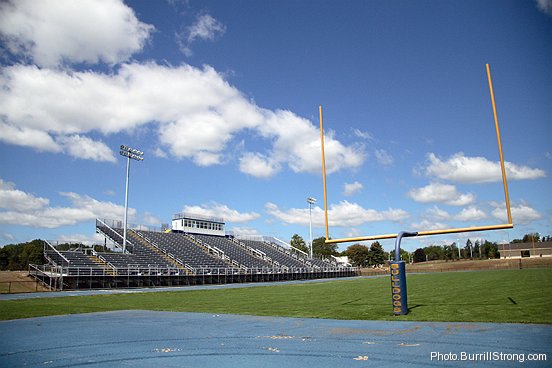
Last year, Chelsea High School (2006 enrollment: 1,022; class: B) completed the renovations of its football stadium; after several years of enduring a woefully-overmatched home seating area, one of the biggest improvements was the expansive new bleachers. The renovated stadium is now a point of pride for the football program.

Yesterday I traveled through the western side of the state, between Kalamazoo and South Haven. Being the high school sports fan I am, I couldn’t resist taking a look at the football stadiums in two of the small towns I encountered; what I found was a startling contrast.

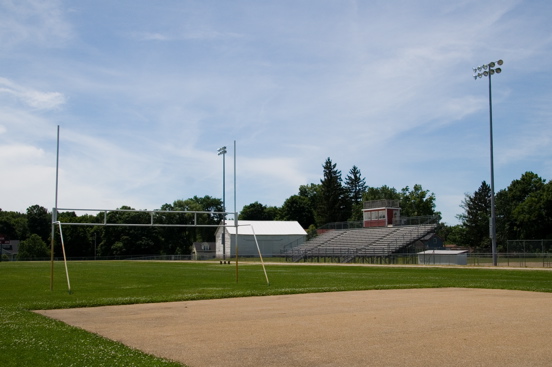
One small town was Bloomingdale. The city itself is quite small, but the school had a 2006 enrollment of 355 (class: C). The high school looked new, but the football stadium was quite old. At first, I wasn’t sure it was actually the high school stadium. But I didn’t see a new stadium near the new high school, and it’s hard to believe such a small school district would maintain more than one lighted field. (Plus, a sign at the entrance referred to the BHS track.)

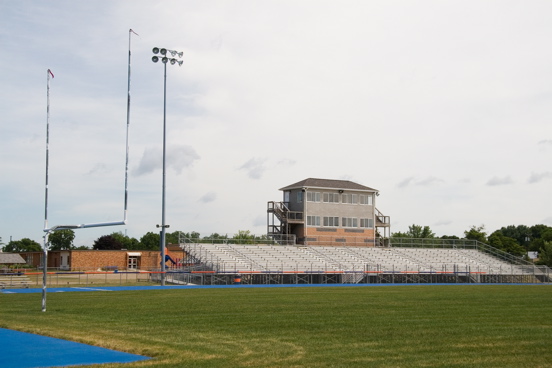
The other small town was Gobles. The downtown of Gobles seemed a bit more developed, but the school is practically the same size as Bloomingdale’s; 2006 enrollment was 368 (class: C); however, the football stadium was stunning. It outclassed Bloomingdale’s stadium, but that doesn’t really give it much credit. In my estimation, it rivals not just Chelsea’s stadium, but those of some small colleges. For a town as small as Gobles to have the high school stadium it does, there must be a serious love for football there.

If Chelsea football didn’t occupy my Friday nights in the fall, I just might consider seeing a game at Gobels, just to see if the atmosphere matches the stadium.

(Pertinent information: Michigan schools are separated into four classes, with A being the largest and D being the smallest. Chelsea is at the upper end of B.)

(School enrollment figures gleaned from a fascinating listing of Michigan high school football won-loss records since 1950; that list, along with a few other equally wonderful lists, can be found on michigan-football.com.)

We interrupt this sport to bring you more scoring

My anger burns with the fire of a thousand Bob Knights:

Even folks who do follow the NHL in the United States — and there aren’t many anymore — can’t be enjoying the post-season much because, let’s face it, there hasn’t been nearly enough scoring.

One goal in 60 minutes, as was the case when the Anaheim Ducks edged the Ottawa Senators Wednesday night in the second game of the Stanley Cup final, simply doesn’t cut it.

Um … no. More scoring does not automatically make a sport better. It may help TV ratings, but please please please, let’s not confuse improved TV ratings with an improved sport. They are not necessarily the same. Low-scoring games may be a bit less TV-friendly, but that does not make them dull or unwatchable — it only makes them less TV-friendly. And as a sports fan, I certainly hope being TV-friendly is not the highest goal of sports.

Say it with me: 1-0 hockey games aren’t bad. Low scoring is not inherently bad, high-scoring is not inherently good, and sports are not at their best when they exist for the enrichment of TV networks.

(Full article.)

How much aluminum could an aluminumchuck chuck?

A few weeks ago, the New York City Council chose to ban aluminum bats in high school baseball, saying a move back to wood bats would make the game safer; more recently, the Detroit Free Press decided to run a story with local opinion on the topic of aluminum bats. And for that story, they happened to contact a very familiar baseball coach:

Chelsea baseball coach Wayne Welton, who has been coaching for 30 years, wouldn’t mind switching to wooden bats.

Welton’s preference for wood bats wasn’t a surprise to me, but I was interested to note that he does not consider it a safety issue.

“I just think that so many kids get a false sense that they’re pretty good hitters using that big barrel of the metal bat,” Welton said.

[…]

“If we used wood bats, we would develop better hitters,” he said.

And he has one other problem with aluminum bats:

“That ‘ping’ sound makes me cringe today,” he said. “I’d much rather hear the crack of the wood, myself.”

Welton’s quotes also made an appearance at the end of a Freep article concerning the likelihood of a similar ban in Michigan.

(If the Freep links are cantankerous, try reading the stories here and here.)

All things to all people

If you’re like me, you aren’t exactly thrilled when Erin, the pink-haired star of the odd Esurance commercials, invades your TV. I know I’m eagerly awaiting the day Erin and her barely-useful unnamed costar will be relegated to the TV Advertising Retirement Home, where they will stare off into space, let food dribble down their chins and, in their more lucid moments, join the Budweiser whassup guys in fondly remembering their glory days on the American airwaves.

(Official Mindreader accountant Buckley wonders about the target audience for those Esurance ads; he says they seem to be directed towards 12-year-old boys. And 12-year-old boys, of course, do not purchase car insurance. But that is a tangent.)

Within the stable of Erin Esurance commercials, there are sports-themed commercials for each of the four major sports: football, basketball, baseball and hockey. Since it’s playoff time and I’m watching plenty of sports, I am all too familiar with the Esurance sports commercials. Tonight was a Pistons playoff game, so I was inundated with Erin on the basketball court.

In the Esurance basketball commercial, Erin is struggling to defeat large (seriously, they must be 20 feet tall) robots who have the audacity not just to completely disrespect the small flying referee, but also to sport 1970s-style headbands, wristbands and facial hair while they’re at it. With only a few seconds left in the game, Erin’s coach — the aforementioned barely-useful unnamed costar, who seems to have embraced the 1970s facial hair theme — draws up a magical game-ending play named “Quote, Buy, Print.” The ever-perky Erin struts onto the court, baffles the audacious robots with off-the-hook basketball moves and dunks the ball to win the game. (In a particuarly amusing moment, as she is flying towards the hoop, her ponytail holder pops off, thus freeing her hair to be glamorous. Apparently she could not truly win without being an animahottie.)

Thanks to the NCAA basketball tournament, I’ve seen that commercial far too many times; however, this time, something caught my eye. There seemed to be an extra element in the commercial: later in the commercial, as Erin is soaring through the air to confront the last remaining giant robot, I thought I spotted a familiar team logo on her uniform. But I wasn’t completely sure, so while I waited for the commercial to air again (truly, something I never thought I would actually want), I checked the commercial Esurance offers on its website:

And when the commercial aired again a few minutes later, I took a picture of that same part of the commercial (I apologize for the poor picture quality; photographing a TV is problematic anyway, and the station does not come in particularly clearly for us):

When I saw the second picture, my suspicions were confirmed: to localize the commercial for the Detroit area, not only did they change her blue, green and white Esurance uniform to a red, white and blue Pistons uniform, but they added the Pistons wordmark on her jersey. They even removed the Esurance logo on her shorts and added a Pistons P. And if they made that effort for Detroit, I presume other NBA markets received a similar treatment.

I still won’t shed a tear when Esurance ends this campaign, but really, that attention to detail is pretty cool. Especially because that detail really isn’t that noticeable (unless you’re strange like me). So, Esurance: well done.

And Erin Esurance: go away.

The Jackson 200

On Monday morning, a group from Immanuel Bible Church — my parents’ church — traveled to Jackson to take a tour of the New Tribes Bible Institute. Thanks to my self-unemployment and a dearth of sports events due to Chelsea schools’ spring break, I was able to join the group for the tour.

As a part of the New Tribes mission organization, NTBI’s purpose is to equip believers for missions by providing a concentrated but thorough Bible education. After two years at NTBI, many students go on to further training for mission fields all over the world.

The student population of NTBI ranges from young singles to married couples with young children; that diversity of stages of life is a benefit to the entire range of students as they interact. And there is plenty of interaction; the school is contained in one building, so the 200 or so students live under the same roof.

NTBI is housed in an old Jackson public middle school building that New Tribes was able to acquire from the city. Since the school building was built back when the city likely was a bit more prosperous — NTBI has inhabited the building for a number of years — it is a good-sized building, and it is well-suited for the school.

Thanks to my photo work, I spend a fair amount of time in and around public school buildings, and it has been my experience that for whatever reasons, many public school buildings do not age extraordinarily well; it seems that when public school buildings are old, they tend to be a bit like Michigan’s Crisler Arena — functional but slightly dingy and not entirely pleasant. So, between my mental image of typical older school buildings and the general somewhat run-down condition of Jackson, I was curious to see the interior of the NTBI facility.

As we took our tour, I was impressed by the clean, bright, pleasant building; the NTBI staff has done an excellent job of maintaining the school. It didn’t feel like an old dingy school building; it felt like a place that is very much alive. Unsurprisingly, the NTBI-owned houses around the school building were equally well-maintained.

More importantly, the building was representative of its occupants; the school exists for the glory of God, and that spirit — or Spirit — was apparent. Throughout our visit, the staff and the students were a credit to NTBI; everyone we met was pleasant and welcoming.

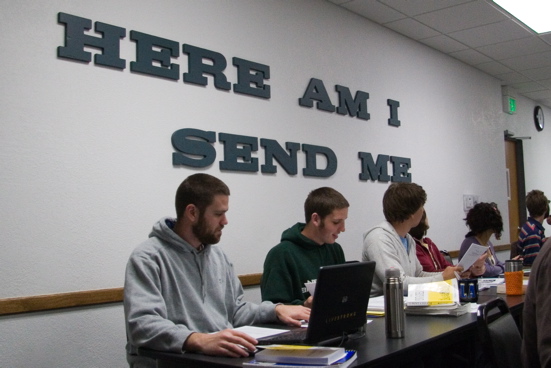
As part of our tour, we were able to attend both a chapel service and a hermeneutics class. The chapel speaker spoke of finishing strong and not taking shortcuts or giving only a minimum effort; the hermeneutics professor gave an introduction to the interpretation of the Bible. Both were thoroughly worthwhile.

After the hermeneutics class, our time at the school concluded with lunch in the school’s cafeteria; instead of standard cafeteria fare, we were pleased to discover that they serve actual food at NTBI. (Monday’s lunch was baked ziti, if you were curious.) While we ate, we had a very pleasant conversation with one of the students, a senior named Amanda.

For me, the tour of NTBI was encouraging; this world can be a dark place, so it meant a great deal to see the light of God reflected in the staff and the students.

—–

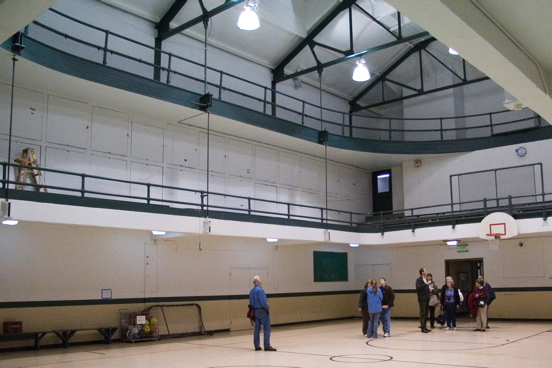
On a different note, the high school sports photographer in me was interested to see what athletic facilities they’d kept from the old middle school; I get to see plenty of venues, both old and new, but I most enjoy seeing old local venues — facilities with history. And while the swimming pool seemed well-maintained, it was the old gym that caught my eye.

Because it was an old middle school, the gym was fairly small; I didn’t measure the floor, but it was clearly not large enough to hold a modern regulation high school basketball court (note the proximity of the center circle and the free throw line). But that didn’t matter to me; I was too interested in the three-tier construction of the gym.

The first level was the gym floor; the second was spectator seating; the third was a running track, complete with banked turns. Elevated tracks have become a common feature in high school gyms in recent years, including Chelsea’s and Dexter’s new gyms, but I didn’t realize the idea went so far back.

Cry me an Olentangy River

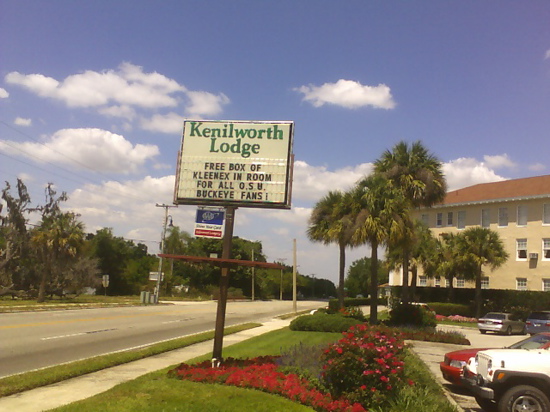
Today is a cloudy, cold, blustery day with intermittent snow and high wind gusts. (Happy spring break, Chelsea students!) But none of that matters, because Annette, a loyal friend of the mindreader, sent me a ray of sunshine she received from Florida.

Believe me, I have no love in my heart for the Gators. (Less and less every day, in fact.) But I’m a Michigan fan, and that sign … well, that just warms my heart.

In other Ohio State news, we are learning more about Columbus’ definition of safe. Let’s compare:

Can you guess which university president, apparently pleasantly surprised by the numbers, hailed its celebration as “safe”?

Spring Silliness in Shorts and Sneakers

For me, watching the NCAA basketball tournament is like watching the Lions: it’s occasionally frustrating, often inexplicable … and yet it draws me like Florida draws whiny football coaches. Okay, maybe not quite that much, but I am a sports fan. (Besides, I’m in a pool.)

Anyway, a few thoughts from the first few rounds of this year’s tournament:

  • Obviously, CBS doesn’t highlight attendance deficits, but they also can’t always hide the empty seats. Even into the third round, I have been a bit surprised at the number of empty lower bowl seats. Last night, I had no problem spotting blocks of empty seats at the Ohio State/Tennessee game; tonight I’m seeing them at the Florida/Butler game. When do the games start drawing capacity crowds?
  • At the beginning of the year, Ohio State freshman Greg Oden was hyped as one of the best player in the nation. I have a question for the more basketball-minded among us: is he really an elite player? The two times I’ve watched him play, he’s gotten in early foul trouble and played limited minutes, and his team won without him. For his sake, I hope those were isolated incidents.
  • More generally, I dislike the offensive bias in basketball. Actually, I’m not too fond of it in most sports, but I’m watching basketball right now, so it’s on my mind. Most basketball fouls are a mystery to me anyway, but it bothers me to no end that defensive players are whistled for seemingly pedestrian bumps while offensive players are given the liberty of backing into a defender and creating space for a shot near the basket. Maybe there’s something I’m missing (likely), but it irks me nonetheless.

Well, aren’t we just special!

It seems like it’s always playoff time in one sport or another, and it seems like playoffs excel at prompting suggestions for improvements. Consider this one more voice in the cacophony.

In most of the civilized world — and the United States, too! — playoffs consist of only a certain number of teams eliminating each other until one team is left. Some systems, like the NFL playoffs and the NCAA basketball tournament, are single-elimination; others, like the NBA or NHL playoffs, consist of multiple series (typically 5- or 7-game series). But all have some standard of entry.

Well, almost all.

The Michigan High School Athletic Association (MHSAA) basketball playoffs began last week. These playoffs are curious for several reasons, the most prominent of which is the standard of entry. Simply put, there is no standard.

In Michigan, every basketball team gains entry to the playoffs, regardless of record or conference standing. Teams whose only consistency was in losing march into the postseason alongside teams that feasted on those losing teams in the regular season. And to add to the curiosity, thanks to the random seeding at the district level, there’s no telling who will be given a first-round bye.

This makes for some odd playoff situations. Chelsea finished the regular season 19-1; the Bulldogs were considered not just the top team in the area, but among the top 10 in the state. But when the district pairings were released, Chelsea did not have a first-round bye. Who did receive a first-round bye? Erie Mason, a team that finished the regular season 2-18. And only two other teams in the district had winning records (Ida and Milan, both at 12-8); the remaining two, Brooklyn Columbia Central and Carleton Airport, were well below .500 at 5-15 and 1-19.

This also makes for humiliating playoff situations. After easily dispatching with Milan in the first round, 63-36, Chelsea moved on to face Erie Mason; as everyone expected, Chelsea won. But they didn’t just win; they won in a blowout, 85-26. Even more than the Milan game, the outcome was never in doubt; for Chelsea, it was simply a practice cleverly packaged as meaningful competition. That continued in the district finals, as Chelsea coasted to a 77-36 victory over Carleton Airport.

Chelsea’s wasn’t the only district featuring losing teams; every district included at least one lowly team. One class C district featured four losing teams: Greenhills (0-19), Inkster (5-14), Riverview Gabriel Richard (4-16) and Romulus Summit Academy (4-16); one class A district featured six losing teams: Adrian (7-13), Lincoln (7-13), Monroe (9-11), Saline (5-15), Tecumseh (6-14) and Temperance Bedford (8-12). There wasn’t room for a winning team.

Districts such as the sub-.500 group cause some to call for coherent organization — which means seeding — at the district level, but this is not a solution; seeding could have one of two effects, depending on its implementation: it could evenly distribute the winning and losing teams, or it could more evenly match teams in the first round.

The former would provide more expedient elimination of the losing teams. With few exceptions, the winning teams would tear through their considerably weaker opponents, much like Chelsea’s Trogdor-like destruction of its weak district; while this might provide a few more interesting second-round games, it would cancel out its potential benefits by guaranteeing too many cakewalks in the first round. This option may improve the second round to some degree, but in most cases, it would do little to improve the first round.

The latter may introduce some interest into the first round by providing more even matchups, but it is difficult to ignore the lowly records of the worst teams in the tournament. A 2-18 team may be evenly matched with a 1-19 team, but the quality of basketball likely will be middling at best. And no matter the winners of those games, they still would be walking from their even matchups into games against far superior opponents, at which point a vast majority of the losing teams would suffer the nearly-inevitable lopsided loss. This option would offer a more realistic — but only marginally meaningful — victory to more losing teams; it would also more quickly eliminate more winning teams. Fortunately, this option also is unlikely.

This playoff situation is not comparable to the NCAA basketball tournament. Unlike their counterparts in the MHSAA basketball playoffs, even the lowest seeds in the NCAA tournament have exhibited some ability to win games. The NCAA has postseason qualification standards; in basketball, the MHSAA does not. The lowest NCAA seeds gain entry through merit; the lowest MHSAA teams gain entry simply by existing.

Ultimately, the idea of guaranteeing even the most miserable team a playoff berth — typically a reward for some sort of regular-season success — is bad for everyone. For the good teams, it gives them not a game, but an unnecessary scrimmage; for the bad teams, it gives them hopeless losses; for the fans, it provides little reason to travel — in Chelsea’s case, a 40-minute trip for its three district games — to watch a blowout. For the most significant improvement, this system requires more than simple reorganization; it requires standards. Any standards.

Football, an equally popular high school sport, recently instituted its own playoff standards. Teams playing nine-game schedules must win six games to qualify; teams playing eight-game schedules must win five games. If there aren’t enough qualifying teams to fill the 256-team field, near-qualifying teams — like Chelsea’s 5-4 playoff team from 2005 — complete the field. As with any system, there are some complications, but in general, it’s easy enough to understand: if you win enough games, you’ll make the playoffs; if you don’t, you won’t.

The specifics of any potential basketball standards would be debated — how many wins is enough? How many teams in the field? How many rounds? — but that would be a welcome debate. It would be the first step in changing a playoff system that suffers because it simply can’t say no.

What if they gave a basketball game and nobody came?

Apparently there is a crisis at Crisler Arena: this year’s attendance for Michigan men’s basketball is on track to finish the season at a 25-year low. The per-game average through mid-February was 9,704; Crisler’s capacity is 13,751.

The drop in attendance isn’t surprising to many people; Michigan basketball is in the doldrums. There has been only a brief hope of an NCAA tournament berth under coach Tommy Amaker, and the team frittered away that glimmer of hope with a pile of losses at the end of the season. NIT berths and winning records are glimmering baubles to which Amaker and athletic director Bill Martin point in the hopes of distracting the fan base from the persistent mediocrity of the program, but obviously, it’s not working.

While the decline of fan interest is sad, it is not as disheartening as the apparent bewilderment in the athletic department. An Ann Arbor News article about the declining numbers included this quote:

“In some games, I’ve especially noticed it. You look around and say: ‘That’s not a big crowd for such a big game,'” senior forward Brent Petway said. “I don’t know what we can really do because we started off with a really good record. I don’t know what more we can say to get people to come out.”

Really, the surprise is not that the fans are losing interest, but that Petway doesn’t understand the reason fans weren’t attracted to Michigan’s 12-3 nonconference record. (Hint: the three losses were to the three quality opponents.) This isn’t about saying the right things to draw fans; it’s about doing the right things to draw fans.

Still, that outlook might be understandable coming from one of the players. But later in the article, an athletic marketing employee offered this:

What’s the biggest challenge in selling Michigan basketball?

“Getting people to the nonconference games,” said Clark Riley, who oversees the program’s marketing. “Even people who buy season tickets don’t go to the nonconference games.”

These quotes from Petway and Riley lead one to wonder if they have looked at Michigan’s nonconference schedule. Consider the basketball powerhouses Michigan lured to Crisler Arena this season: Central Connecticut State; Davidson; Wisconsin-Milwaukee; Youngstown State; Maryland-Baltimore County; Wofford; Delaware State.

And Petway and Riley wonder why the fan base doesn’t fill the seats for those games?

At the end of the article, Martin seems to come the closest to grasping a part of the problem:

“A lot of it is a function of who your opponent is,” Martin said. “Our season-ticket base of students and regular-season ticket holders has held up real well. But (attendance) is not where we want it.”

But sadly, that’s not the entire problem. In fact, it’s not even “a lot” of the problem. Without a doubt, fans want to see quality opponents — but they also want to see a quality home team. Where is the quality home team? It doesn’t exist.

Sure, Amaker’s teams have posted winning seasons, but the bulk of the victory feasts have occurred against the aforementioned tissue-soft nonconference schedule. When the team does meet an opponent of any real quality, more often than not, the result is a loss.

The previous and current solution to that problem, it seems, has been to schedule far more Kleenex opponents than quality opponents. That way, the team puts together an ostensibly impressive nonconference record. The problem that Amaker and Martin are discovering is that an impressive nonconference record in that context means almost nothing to the fans, or to anyone else.

To illustrate the problem, let’s go to the movies for a moment. No matter what ancillary attractions a theater throws at the public, a B-movie won’t gross $25 million on any weekend. Nothing changes the fact that the attraction — the movie — simply isn’t that good. Customers come to the theater for the movie; if the movie isn’t good, customers will stop coming. To lure customers, you first need a good movie.

At Crisler, Amaker essentially is providing Michigan fans a B-team: there are flashes of both good and bad play, but the bulk is simply mediocre, with no indications of improvement in the program. That’s a major problem. But in examining the problem of attendance, Martin seems to want to approach it through the issue of the B-, C- and D-team nonconference schedule. And while the schedule is Martin’s bailiwick, tweaking its strength is not the long-term solution to Crisler’s attendance woes.

As athletic director, Martin has to think about more than tweaking the schedule to draw a few fans for a few games. He has to think less about the teams he brings to town and more about the team that stays in town. Fan interest is only briefly stoked by marquee opponents; give the fans their own marquee team, and they’ll fill the seats.

Otherwise, it’s just a bad movie with good popcorn.